<?xml version="1.0" encoding="utf-8"?><feed xmlns="http://www.w3.org/2005/Atom" xml:lang="en"><generator uri="https://jekyllrb.com/" version="4.3.2">Jekyll</generator><link href="https://the.curlybracket.net/atom.xml" rel="self" type="application/atom+xml" /><link href="https://the.curlybracket.net/" rel="alternate" type="text/html" hreflang="en" /><updated>2023-12-30T17:30:33+01:00</updated><id>https://the.curlybracket.net/atom.xml</id><title type="html">curlybracket</title><subtitle>curlybracket - This is my old blog and resource collection.</subtitle><author><name>curlybracket</name></author><entry><title type="html">How do kids conceive the internet? - part 4</title><link href="https://the.curlybracket.net/2023/12/30/internet-kids-pt4.html" rel="alternate" type="text/html" title="How do kids conceive the internet? - part 4" /><published>2023-12-30T00:00:00+01:00</published><updated>2023-12-30T00:00:00+01:00</updated><id>https://the.curlybracket.net/2023/12/30/internet-kids-pt4</id><content type="html" xml:base="https://the.curlybracket.net/2023/12/30/internet-kids-pt4.html"><![CDATA[<p>Read all parts of the series
<a href="https://the.curlybracket.net/2022/03/31/internet-kids.html">Part 1</a>
// <a href="https://the.curlybracket.net/2022/05/20/internet-kids-pt2.html">Part 2</a>
// <a href="https://the.curlybracket.net/2022/05/23/internet-kids-pt3.html">Part 3</a>
// Part 4</p>

<p>I’ve been wanting to write this post for over a year, but lacked energy
and time. Before 2023 is coming to an end, I want to close this series
and share some more insights with you and hopefully provide you with a
smile here and there.</p>

<p>For this round of interviews, four more kids around the ages of 8 to 13
were interviewed, 3 of them have a US background—these 3
interviews were done by a friend who recorded these interviews for me,
thank you!</p>

<p>As opposed to the previous interviews, these four kids have parents who
have a more technical professional background.  And this seems to make a
difference: even though none of these kids actually knew much better how
the internet really works than the other kids that I interviewed,
specifically in terms of physical infrastructures, they were much more
confident in using the internet, they were able to more correctly name
things they see on the internet, and they had partly radical ideas about
what they would like to learn or what they would want to change about
the internet!</p>

<p>Looking at these results, I think it’s safe to say that social
reproduction is at work and that we need to improve education for kids
who do not profit from this type of social and cultural wealth at home.</p>

<p>But let’s dive into the details.</p>

<h2 id="the-boy-and-the-aliens">The boy and the aliens</h2>

<p>(I’ll be mostly transribing the interview, which was short, and which I
find difficult to sum up because… some of the questions are written
in a way to encourage the kids to tell a story, and this particular kid
had a thing going on with aliens.)</p>

<p>He’s a 13 year old boy living in the US. He has his own computer, which
technically belongs to his school but can be used by him freely and he
can also take it home.</p>

<p>He’s the first kid saying he’s reading the news on the internet; he does
not actually use social media, besides sometimes watching TikTok.</p>

<p>When asked: <strong>Imagine that aliens land and come to you and say: “We’ve
heard about this internet thing you all talk about, what is it?” What do
you tell them?</strong> he replied:</p>

<blockquote>
  <p>Well, I mean they’re aliens, so I don’t know if I wanna tell them
much.</p>
</blockquote>

<p>(Parents laughing in the background.)</p>

<p><strong>Let’s assume they’re friendly aliens.</strong></p>

<blockquote>
  <p>Well, I would say you can look anything up and play different games.
And there are alien games. But mostly the enemies are aliens which you
might be a little offended by. And you can get work done, if you
needed to spy on humans. There’s cameras, you can film yourself, yeah.
And you can text people and call people who are far away…</p>
</blockquote>

<p><strong>And what would be in a drawing that would explain the internet?</strong></p>

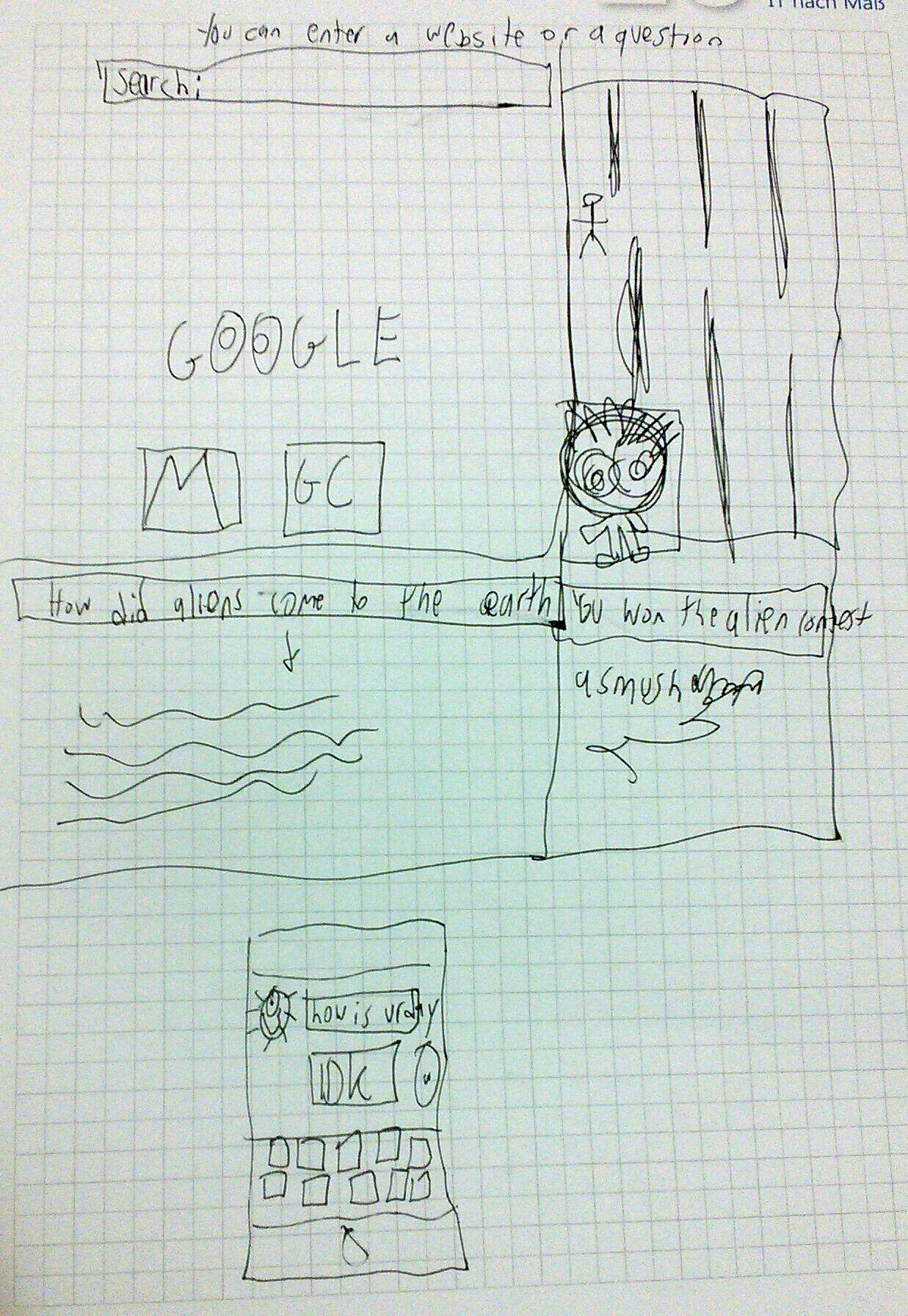
<p><img src="https://the.curlybracket.net/assets/images/blog/alien-boy.jpg" alt="Google, an alien using Twitch, Google search results, and the interface of an IM software on an iPhone drawn by a 13 year old boy" /></p>

<p>And here’s what he explains about his drawing:</p>

<blockquote>
  <p>First, I would draw what I see when you open a new tab, Google.</p>
</blockquote>

<p>On the right side of the drawing we see something like Twitch.</p>

<blockquote>
  <p>I don’t wanna offend the aliens, but you can film yourself playing a
game, so here is the alien and he’s playing a game.</p>
</blockquote>

<blockquote>
  <p>And then you can ask questions like: How did aliens come to the Earth? And
the answer will be here (below). And there’ll be different websites
that you can click on.</p>
</blockquote>

<blockquote>
  <p>And you can also look up “Who won the alien contest?” And that would
be Usmushgagu, and that guy won the alien contest.</p>
</blockquote>

<p><strong>Do you think the information about alien intergalactic football is
already on the internet?</strong></p>

<blockquote>
  <p>Yeah! That’s how fast the internet is.</p>
</blockquote>

<p>On the bottom of the drawing we see an iPhone and an instant messaging software.</p>

<blockquote>
  <p>There’s also a device called an iPhone and with it you can text your
friends. So here’s the alien asking: “How was ur day?” and the friend
might answer “IDK” [I don’t know].</p>
</blockquote>

<p><strong>Imagine that a wise and friendly dragon could teach you one thing about
the internet that you’ve always wanted to know. What would you ask the
dragon to teach you about?</strong></p>

<blockquote>
  <p>Is there a way you don’t have to pay for any channels or subscriptions
and you can get through any firewall?</p>
</blockquote>

<p><strong>Imagine you could make the internet better for everyone. What would you do first?</strong></p>

<blockquote>
  <p>Well you wouldn’t have to pay for it [paywalls].</p>
</blockquote>

<p><strong>Can you describe what happens between your device and a website when you
visit a website?</strong></p>

<blockquote>
  <p>Well, it takes 0.025 seconds. […] It’s connecting.</p>
</blockquote>

<p>Wow, that’s indeed fast! We were not able to obtain more details about
what is that fast thing that’s happening exactly…</p>

<h2 id="the-software-engineers-kid">The software engineer’s kid</h2>

<p>This kid identifies as neither boy nor girl, is 10 years old and lives
in Germany. Their father works as a software engineer, or in the words
of the child:</p>

<blockquote>
  <p>My dad knows everything.</p>
</blockquote>

<p>The kid has a laptop and a mobile phone, both with parental
control—they don’t think that the controlling is fair.</p>

<p>This kid uses the internet foremostly for listening to music and
watching prank channels on Youtube but also to work with Purple Mash (a
teaching platform for the computing curriculum used at their school),
finding 3d printing models (that they ask their father to print with
them because they did not manage to use the printer by themselves yet).
Interestingly, and very differently from the non-tech-parent kids, this
kid insists on using Firefox and Signal - the latter is not only used by
their dad to tell them to come downstairs for dinner, but also to call
their grandmother. This kid also shops online, with the help of the
father who does the actual shopping for them using money that the kid
earned by reading books.</p>

<p><strong>If you would need to explain to an alien who has landed on Earth what
the internet is, what would you tell them?</strong></p>

<blockquote>
  <p>The internet is something where you search, for example, you can look
for music. You can also watch videos from around the world, and you
can program stuff.</p>
</blockquote>

<p>Like most of the kids interviewed, this kid uses the internet mostly for
media consumption, but with the difference that they also engage with
technology by way of programming using Purple Mash.</p>

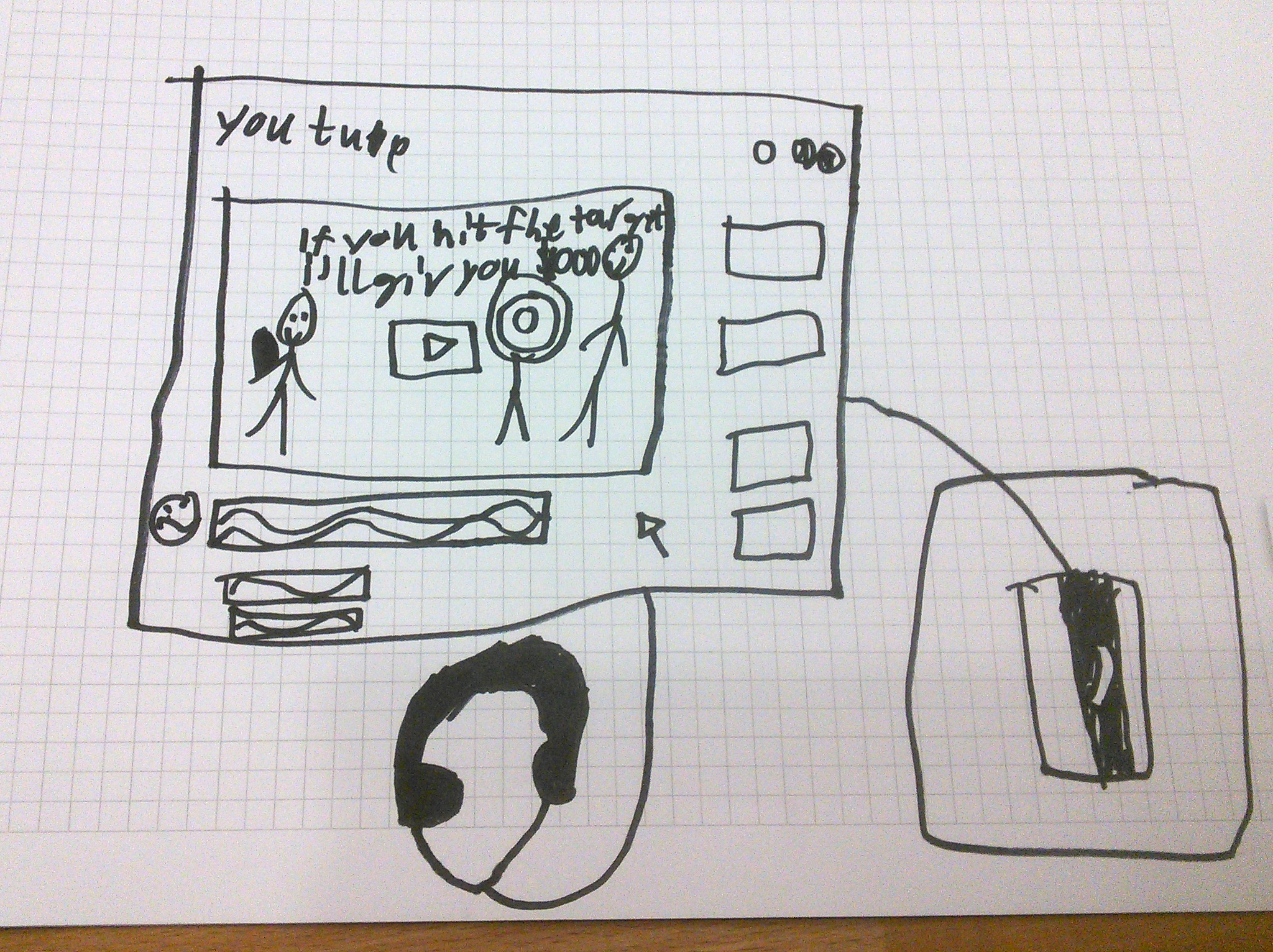
<p><img src="https://the.curlybracket.net/assets/images/blog/software-engineer-kid.jpg" alt="drawing of the internet by a 10 year old showing a Youtube prank channel, an external device trackpad, and headphones" /></p>

<p>In their drawing we see a Youtube prank channel on a screen, an external
trackpad on the right (likely it’s not a touch screen), and headphones.
Notice how there is no keyboard, or maybe it’s folded away.</p>

<p><strong>If you could ask a nice and friendly dragon anything you’d like to
learn about the internet, what would it be?</strong></p>

<blockquote>
  <p>How do I shutdown my dad’s computer… forever?</p>
</blockquote>

<p><strong>And what is it that he would do to improve the internet for
everyone?</strong></p>

<p>Contrary to the kid living in the US, they think that</p>

<blockquote>
  <p>It takes too much time to load stuff!</p>
</blockquote>

<p>I wonder if this kid experiences the internet as being slow because they use
the mobile network or because their connection somehow gets throttled as a
way to control media consumption, or if the German internet
infrastructure is just so much worse in certain regions…</p>

<p><strong>If you could improve the internet for everyone, what would you do
first?</strong></p>

<p>I’d make a new Firefox app that loads the internet much faster.</p>

<h2 id="the-software-engineers-daughter">The software engineer’s daughter</h2>

<p>This girl is only 8 years old, she hates unicorns, and her dad is also a
software engineer. She uses a smartphone, controlled by her parents.  My
impression of the interview is that at this age, kids slightly mix up
the internet with the devices that they use to access the internet.</p>

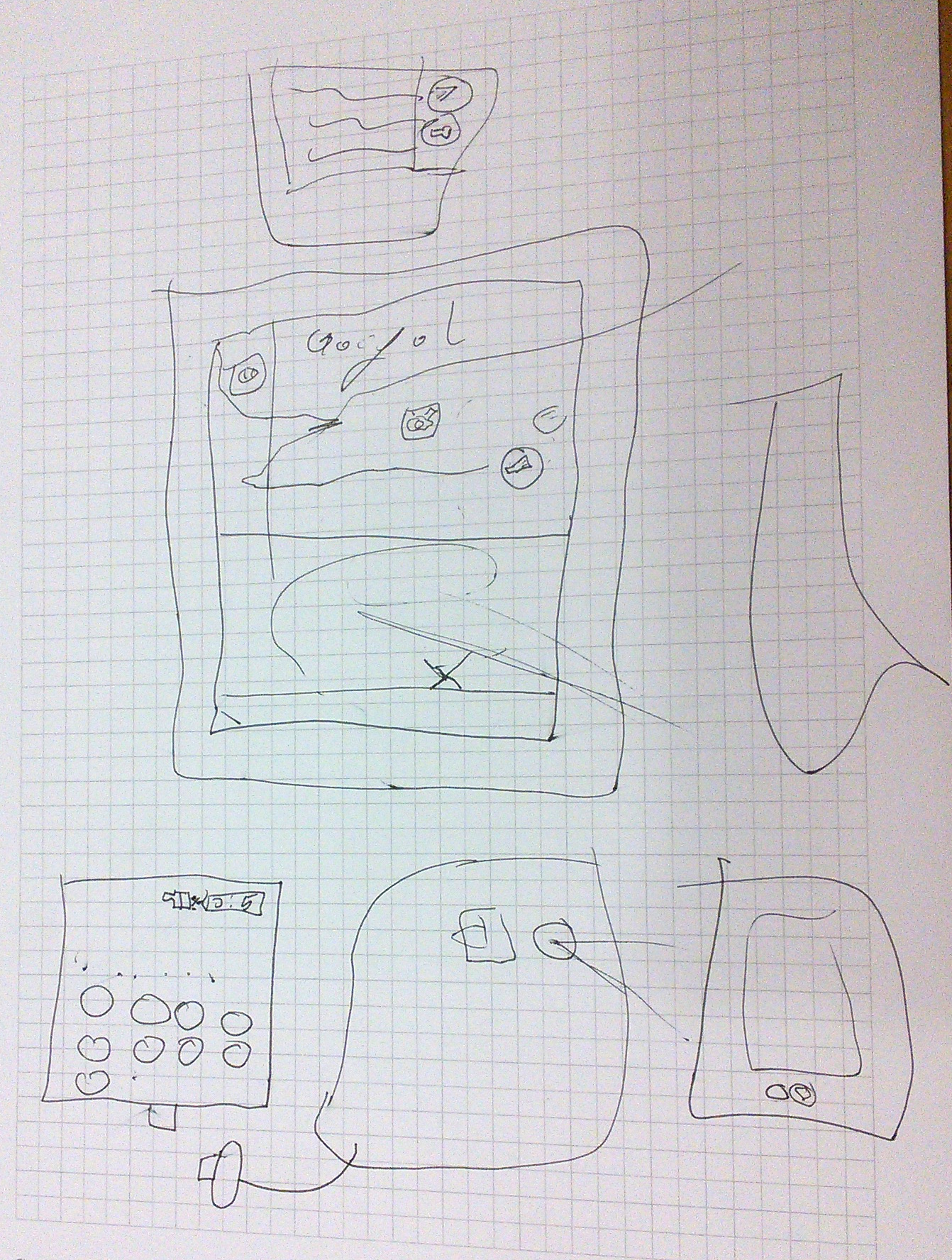
<p><img src="https://the.curlybracket.net/assets/images/blog/software-engineer-daughter.jpg" alt="drawing of the internet by an 8 year old girl, Showing Google and the interface to call and text someone" /></p>

<p>In her drawing, we see again Google - it’s clearly everywhere - and also
the interfaces for calling and texting someone.</p>

<p>To explain what the internet is, besides the fact that one
can use it for calling and listening to music, she says:</p>

<blockquote>
  <p>[The internet] is something that you can [use to] see someone who is
far away, so that you don’t need to take time to get to them.</p>
</blockquote>

<p>Now, that’s a great explanation, the internet providing the possibility
for communication over a distance :)</p>

<p>If she could ask a friendly dragon something she always wanted to know,
she’d ask how to make her phone come alive:</p>

<blockquote>
  <p>that it can talk to you, that it can see you, that it can smile and
has eyes. It’s like a new family member, you can talk to it.</p>
</blockquote>

<p>Sounds a bit like Siri, Alexa, or Furby, doesn’t it?</p>

<p><strong>If you could improve the internet for everyone, what would you do
first?</strong></p>

<p>She’d have the phone be able to decide over her free time, her phone
time. That would make the world better, not for the kids, but certainly
for the parents.</p>

<h2 id="the-antifascist-kid">The antifascist kid</h2>

<p>This German boy’s dad has a background in electrotechnical engineering.
He’s 10 years old and he told me he’s using the internet a lot for
searching things for example about his passion: the firefighters. For
him, the internet is:</p>

<blockquote>
  <p>An invisible world. A “virtual” world. But there’s also the darknet.</p>
</blockquote>

<p>He told me he always watches that German show on public TV for kids that
explains stuff: <em>Checker Tobi</em>. (In 2014, <a href="https://www.youtube.com/watch?v=i7cYePelQH4" target="_blank"><em>Checker Tobi</em> actually produced an episode about the
internet</a>, which I’d criticize for having only male characters,
except for one female character: a secretary—Google, a nice and
friendly woman guiding the way through the huge library that’s the
internet…)</p>

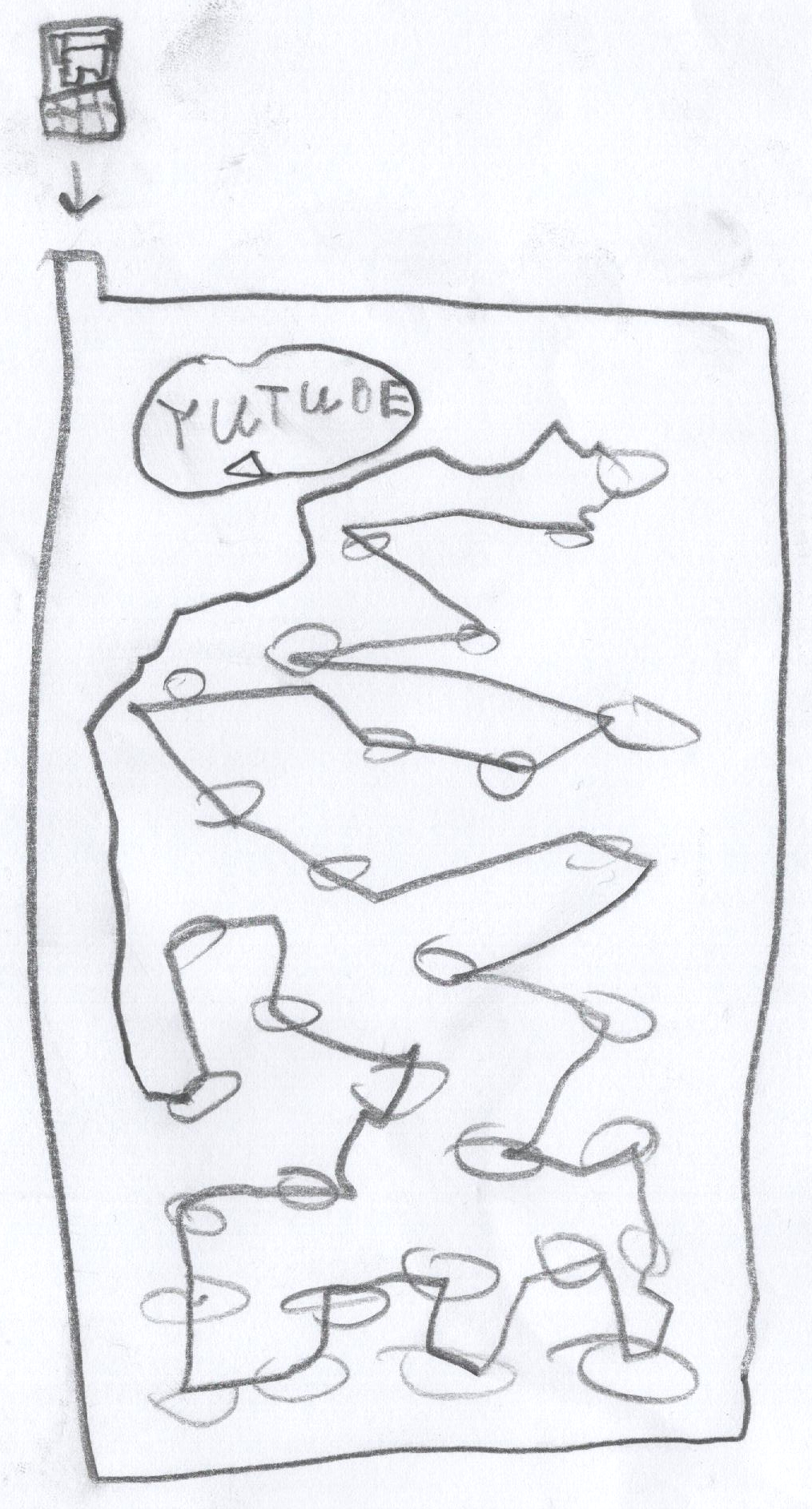
<p>This kid was the only one interviewed who managed to actually explain
something about the internet, or rather about the hypertextual structure
of the web. When I asked him to draw the internet, he made a drawing of
a pin board. He explained:</p>

<blockquote>
  <p>Many items are attached to the pin board, and on the top left corner
there’s a computer, for example with Youtube and one can navigate like
that between all the items, and start again from the beginning when
done.</p>
</blockquote>

<p><img src="https://the.curlybracket.net/assets/images/blog/antifascist-boy.jpg" alt="hypertext structure representing the internet drawn by a kid" /></p>

<p>When I asked if he knew what actually happens between the device and a
website he visits, he put forth the hypothesis of the existence of some
kind of</p>

<blockquote>
  <p>Waves, internet waves - all this stuff somehow needs to be transmitted.</p>
</blockquote>

<p>What he’d like to learn:</p>

<blockquote>
  <p>How to get into the darknet? How do you become a Whitehat? I’ve heard
these words on the internet, the internet makes me clever.</p>
</blockquote>

<p>And what would he change on the internet if he could?</p>

<blockquote>
  <p>I want that right wing extreme stuff is not accessible anymore, or
at least, that it rains turds (“Kackwürste”) whenever people watch
such stuff. Or that people are always told: ‘This video is scum.’</p>
</blockquote>

<p>I suspect that his father has been talking with him about these things,
and maybe these are also subjects he heard about when listening to punk
music (he told me he does), or browsing Youtube.</p>

<h1 id="future-projects">Future projects</h1>

<p>To me this has been pretty insightful. I might share some more internet
drawings by adults in the future, which I think are also really
interesting, as they show very different things depending on the age of
the person.</p>

<p>I’ve been using the information gathered to work on a children’s
book… which I hope to be able to share with you next year.</p>]]></content><author><name>curlybracket</name></author><summary type="html"><![CDATA[I wanted to understand how kids between 10 and 18 conceive the internet. With the help of a friend, some more kids were interviewed, kids whose parents have a more technical background.]]></summary></entry><entry><title type="html">How volunteer work in F/LOSS exacerbates pre-existing lines of oppression, and what that has to do with low diversity</title><link href="https://the.curlybracket.net/2023/12/21/unpaid-work.html" rel="alternate" type="text/html" title="How volunteer work in F/LOSS exacerbates pre-existing lines of oppression, and what that has to do with low diversity" /><published>2023-12-21T00:00:00+01:00</published><updated>2023-12-21T00:00:00+01:00</updated><id>https://the.curlybracket.net/2023/12/21/unpaid-work</id><content type="html" xml:base="https://the.curlybracket.net/2023/12/21/unpaid-work.html"><![CDATA[<p>This is a post I wrote in June 2022, but did not publish back then.
After first publishing it in December 2023, a perfectionist insecure
part of me unpublished it again. After receiving positive feedback, i
slightly amended and republish it now.</p>

<p>In this post, I talk about unpaid work in F/LOSS, taking on the example
of hackathons, and why, in my opinion, the expectation of volunteer work
is hurting diversity.</p>

<p><strong>Disclaimer:</strong> I don’t have all the answers, only some ideas and questions.</p>

<h2 id="previous-findings">Previous findings</h2>

<p>In 2006, the <a href="https://www.researchgate.net/publication/264799720_FLOSSPOLS_Deliverable_D_16_Gender_Integrated_Report_of_Findings">Flosspols
survey</a>
searched to explain the “role of gender in free/libre/open source
software (F/LOSS) communities because an earlier [study] revealed a
significant discrepancy in the proportion of men to women. It showed
that just about 1.5% of F/LOSS community members were female at that
time, compared with 28% in proprietary software” (which is also a low
number).</p>

<p>Their key findings were, to name just a few:</p>

<ul>
  <li>that “F/LOSS rewards the producing code rather than the producing
software. It thereby puts most emphasis on a particular skill set.
Other activities such as interface design or documentation are
understood as less ‘technical’ and therefore less prestigious.”</li>
  <li>“The reliance on long hours of intensive computing in writing
successful code means that men, who in general assume that time
outside of waged labour is ‘theirs’, are freer to participate than
women, who normally still assume a disproportionate amount of domestic
responsibilities. Female F/LOSS participants, however, seem to be able
to allocate a disproportionate larger share of their leisure time for
their F/LOSS activities. This gives an indication that women who are
not able to spend as much time on voluntary activities have
difficulties to integrate into the community.”</li>
</ul>

<p>We also know from the <a href="https://apo.org.au/sites/default/files/resource-files/2021-12/apo-nid315293.pdf">2016 Debian
survey</a>,
published in 2021, that a majority of Debian
contributors are employed, rather than being contractors, and rather
than being students. Also, 95.5% of respondents to that study were men
between the ages of 30 and 49, highly educated, with the largest groups
coming from Germany, France, USA, and the UK. The study found that only
20% of the respondents were being paid to work on Debian.  Half of these
20% estimate that the amount of work on Debian they are being paid for
corresponds to less than 20% of the work they do there.  On the other
side, there are 14% of those who are being paid for Debian work who
declared that 80-100% of the work they do in Debian is remunerated.</p>

<h2 id="so-if-a-majority-of-people-is-not-paid-why-do-they-work-on-floss-or-what-are-the-incentives-of-free-software">So, if a majority of people is not paid, why do they work on F/LOSS? Or: What are the incentives of free software?</h2>

<p>In 2021, Louis-Philippe Véronneau aka Pollo, who is not only a Debian
Developer but also an economist, published his thesis <a href="https://veronneau.org/what-are-the-incentive-structures-of-free-software.html">What are the
incentive structures of free
software</a>
(The actual thesis was <a href="https://veronneau.org/media/blog/2021-02-17/m%C3%A9moire.pdf">written in
French</a>).</p>

<p>One very interesting finding Pollo pointed out is this one:</p>

<blockquote>
  <p>Indeed, while we have proven that there is a strong and significative
correlation between the income and the participation in a free/libre
software project, it is not possible for us to pronounce ourselves
about the causality of this link.</p>
</blockquote>

<p>In the French original text:</p>

<blockquote>
  <p>En effet, si nous avons prouvé qu’il existe une corrélation forte et
significative entre le salaire et la participation à un projet libre,
il ne nous est pas possible de nous prononcer sur la causalité de ce
lien.</p>
</blockquote>

<p>Said differently, it is certain that there is a relationship between income
and F/LOSS contribution, but it’s unclear whether working on free/libre
software ultimately helps finding a well paid job, or if having a well
paid job is the cause enabling work on free/libre software.</p>

<p>I would like to scratch this question a bit further, mostly relying on
my own observations, experiences, and discussions with F/LOSS
contributors.</p>

<h2 id="volunteer-work-is-unpaid-work">Volunteer work is unpaid work</h2>

<p>We often hear of hackathons, hack weeks, or hackfests. I’ve been at some
such events myself, Tails organized one, the IETF regularly organizes
hackathons, and last week (June 2022!) I saw an invitation for a hack
week with the Torproject. This type of event generally last several
days. While the people who organize these events are being paid by the
organizations they work for, participants on the other hand are
generally joining on a <em>volunteer</em> basis.</p>

<p><strong>Who can we expect to show up at this type of event under these
circumstances as participants?</strong></p>

<p>To answer this question, I collected some ideas:</p>

<ul>
  <li>people who have an employer sponsoring their work</li>
  <li>people who have a funder/grant sponsoring their work</li>
  <li>people who have a high income and can take time off easily
(in that regard, remember the Gender Pay Gap, women often earn less
for the same work than men)</li>
  <li>people who rely on family wealth (living off an inheritance, living on
rights payments from a famous grandparent - I’m not making these
situations up, there <em>are</em> actual people in such financially favorable
situations…)</li>
  <li>people who “don’t need much money” because they don’t have to pay rent
or pay low rent (besides house owners that category includes people who live in squats
or have social welfare paying for their rent, people who live with
parents or caretakers)</li>
  <li>people who don’t need to do care work (for children, elderly family
members, pets. Remember that most care work is still done by women.)</li>
  <li>students who have financial support or are in a situation in which
they do not yet need to generate a lot of income</li>
  <li>people who otherwise have free time at their disposal</li>
</ul>

<p><strong>So, who, in your opinion, fits these unwritten requirements?</strong></p>

<p>Looking at this list, it’s pretty clear to me why we’d mostly find white
men from the Global North, generally with higher education in hackathons
and F/LOSS development. (“Great, they’re a culture fit!”)</p>

<p>Yes, there will also always be some people of marginalized groups who
will attend such events—because they expect to network, to find an
internship, to find a better job in the future, or to add their
participation to their curriculum. To me, this rings a bunch of alarm
bells.</p>

<h2 id="low-diversity-in-floss-projectsa-mirror-of-the-distribution-of-wealth">Low diversity in F/LOSS projects—a mirror of the distribution of wealth</h2>

<p>I believe that the lack of diversity in F/LOSS is first of all a mirror
of the distribution of wealth on a larger level. And by “wealth” I’m
referring to financial wealth as much as to social wealth in the sense
of Bourdieu: Families of highly educated parents <a href="https://www.rnz.co.nz/news/the-wireless/373065/the-pencilsword-on-a-plate" target="_blank">socially reproducing privilege</a> by allowing their
kids to attend better schools, supporting and guiding them in their
choices of study and work, providing them with relations to internships
acting as springboards into well paid jobs and so on.</p>

<p>That said, we should ask ourselves as well:</p>

<h2 id="do-floss-projects-exacerbate-existing-lines-of-oppression-by-relying-on-unpaid-work">Do F/LOSS projects exacerbate existing lines of oppression by relying on unpaid work?</h2>

<p>Let’s look again at the causality question of Pollo’s research (in my
words):</p>

<blockquote>
  <p>It is unclear whether working on free/libre software ultimately helps
finding a well paid job, or if having a well paid job is the cause
enabling work on free/libre software.</p>
</blockquote>

<p>Maybe we need to imagine this cause-effect relationship over time: as a
student, without children and lots of free time, hopefully some money
from the state or the family, people can spend time on F/LOSS, collect
experience, earn recognition - and later find a well-paid job
and make unpaid F/LOSS contributions into a hobby, cementing their
status in the community, while at the same time generating a sense of
well-being from working on the common good.</p>

<p>This is a quite common scenario. As the Flosspols study revealed
however, boys often get their own computer at the age of 14, while girls
get one only at the age of 20. (These numbers might be slightly
different now, and possibly many people don’t own an actual laptop or
desktop computer anymore, instead they own mobile devices which are not
exactly inciting them to look behind the surface, take apart, learn,
appropriate technology.) In any case, the above scenario does not allow
for people who join F/LOSS later in life, eg. changing careers, to find
their place.</p>

<p>I believe that F/LOSS projects cannot expect to have more women, people
of color, people from working class backgrounds, people from outside of
Germany, France, USA, UK, Australia, and Canada on board as long as
volunteer work is the status quo and waged labour an earned privilege.</p>

<h2 id="wait-are-you-criticizing-all-these-wonderful-people-who-sacrifice-their-free-time-to-work-towards-common-good">Wait, are you criticizing all these wonderful people who sacrifice their free time to work towards common good?</h2>

<p>No, that’s definitely not my intention, I’m glad that F/LOSS exists, and
the F/LOSS ecosystem has always represented a small utopia to me that is
worth cherishing and nurturing. However, I think we still need to talk
more about the lack of diversity, and investigate it further.</p>

<h2 id="paid-internships-are-one-key-to-countering-lines-of-oppression">Paid internships are one key to countering lines of oppression</h2>

<p>Lots of projects, even Outreachy and GSoC, require one contribution to
F/LOSS to be made prior to be able to apply for a paid internship. I do
well understand the incentive of this, but it’s quite a high entry
barrier.</p>

<p>In 2014/2015 I was able to have 3 months of work on Debian paid for via
an Outreachy internship. I was extremely grateful for that opportunity
because without this paid internship I would <strong>never</strong> have found the
time to engage with the Debian and F/LOSS ecosystem in depth simply
because I would have had to work on my usual day job; I have rent to
pay, and a health insurance which is really not cheap. These programs
are key because they help counter existing lines of oppression at a
strategic point: they buy someone’s time by providing them a small
income. Back then, the internship was paid 5,500USD gross for 3 months,
meaning after taxes and paying social/health insurance, I was left with
roughly 1100€ per month, really not much money for living decently in
Western Europe, but enough to get started.</p>

<p>By the way, to my knowledge, <a href="https://wiki.debian.org/DebianWomen/Projects/Statistics">4 women who did an Outreachy internship
subsequently became Debian Developers. 3 other female Debian Developers
are or were part of
Outreachy</a> on
the organizer side. I think this shows that this program is a success
that we don’t celebrate enough!</p>

<h2 id="some-types-of-work-are-never-being-paid">Some types of work are never being paid</h2>

<p>Besides free work at hacking events, let me also underline that a lot of
work in F/LOSS is not considered “payable work” (yes, that’s an
oxymoron!). Which F/LOSS project for example, has ever paid translators
a decent fee? Which project has ever considered that doing the social
glue work, often done by women in the projects, is work that should be
paid for? Which F/LOSS projects pay the people who do their Debian
packaging rather than relying on yet another already well-paid white man
who can afford doing this work for free all the while holding up how
great the F/LOSS ecosystem is? And how many people on <a href="https://web.archive.org/web/20220714093619/https://opensourcedesign.net/jobs/">opensourcedesign
jobs</a> are looking to get their logo
or website done for free? (Isn’t that heart icon appealing to your
altruistic empathy?)</p>

<p>In my experience even F/LOSS projects which are trying to “do the right
thing” by paying everyone the same amount of money per hour run into
issues — when it turns out that not all hours are equal and that
some types of work do not qualify for remuneration at all or that the
rules for the clocking of work are not universally applied in the same
way by everyone.</p>

<h2 id="not-every-interaction-should-have-a-monetary-value-but">Not every interaction should have a monetary value, but…</h2>

<p>Some of you want to keep working without being paid, because that feels
a bit like communism within capitalism, it makes you feel good to
contribute to the greater good while not having the system determine
your value over money. I hear you. I’ve been there (and sometimes still
am). But as long as we live in this system, even though we didn’t choose
to and maybe even despise it - communism is not about working for free,
it’s about getting paid equally and adequately.</p>

<p>We may not think about it while under the age of 40 or 45, but working
without adequate financial compensation, even half of the time, will
ultimately result in not being able to care for oneself when sick, when
old. And while this may not be an issue for people who inherit wealth,
or have an otherwise safe economical background, eg. an academic salary,
it is a huge problem and barrier for many people coming out of the
working or service classes.</p>

<p>(Oh and please, don’t repeat the neoliberal lie that everyone can
achieve whatever they aim for, if they just tried hard enough. <a href="https://www.seuil.com/ouvrage/le-destin-au-berceau-camille-peugny/9782021096088" target="_blank">French research shows that (in France) one has only 30%
chance to become a “class defector”, and change social class
upwards</a>. “But I managed to get out and move up, so everyone can!” -
well, if you believe that I’m afraid you might be experiencing <a target="_blank" href="https://en.wikipedia.org/wiki/Survivorship_bias">survivor
bias</a>.)</p>

<h2 id="not-all-bodies-are-equally-able">Not all bodies are equally able</h2>

<p>We should also be aware that not all of us can work with the same amount
of energy either. There is yet another category of people who are
excluded by the expectation of volunteer work, either because the waged
labour they do already eats all of their energy, or because their bodies
are not disposed to do that much work, for example because of mental
health issues - such as depression-, or because of physical
disabilities.</p>

<h2 id="when-organizing-events-relying-on-volunteer-work">When organizing events relying on volunteer work…</h2>

<p>…please think about these things. Yes, you can tell people that they
should ask their employer to pay them for attending a hackathon - but,
as I’ve hopefully shown, that would not do it for many people,
especially newcomers. Instead, you could  propose a fund to make it
possible that people who would not normally attend can attend. DebConf
is a good example for having done this for many years.</p>

<h2 id="conclusively">Conclusively…</h2>

<p>I would like to urge free software projects that have a budget and
directly pay some people from it to map where they rely on volunteer
work and how this hurts diversity in their project. How do you or your
project exacerbate pre-existing lines of oppression by granting or not
granting monetary value to certain types of work? What is it that you
take for granted?</p>

<p>As always, I’m curious about your feedback!</p>

<h2 id="worth-a-read">Worth a read</h2>

<p>These ideas are far from being new. Ashe Dryden’s well-researched post
<a href="https://www.ashedryden.com/blog/the-ethics-of-unpaid-labor-and-the-oss-community">The
ethics of unpaid labor and the OSS community</a> dates back to 2013 and
is as important as it was ten years ago.</p>]]></content><author><name>curlybracket</name></author><summary type="html"><![CDATA[Some thoughts around how volunteer work in F/LOSS exacerbates pre-existing lines of oppression, resulting in low diversity.]]></summary></entry><entry><title type="html">How do kids conceive the internet? - part 3</title><link href="https://the.curlybracket.net/2022/05/23/internet-kids-pt3.html" rel="alternate" type="text/html" title="How do kids conceive the internet? - part 3" /><published>2022-05-23T00:00:00+02:00</published><updated>2022-05-23T00:00:00+02:00</updated><id>https://the.curlybracket.net/2022/05/23/internet-kids-pt3</id><content type="html" xml:base="https://the.curlybracket.net/2022/05/23/internet-kids-pt3.html"><![CDATA[<p>All parts of the series
<a href="https://the.curlybracket.net/2022/03/31/internet-kids.html">Part 1</a>
// <a href="https://the.curlybracket.net/2022/05/20/internet-kids-pt2.html">Part 2</a>
// Part 3
// <a href="https://the.curlybracket.net/2023/12/22/internet-kids-pt4.html">Part 4</a></p>

<p>I received some feedback on the first part of interviews about the
internet with children that I’d like to share publicly here. Thank you!
Your thoughts and experiences are important to me!</p>

<p><strong><a href="https://the.curlybracket.net/2022/03/31/internet-kids.html">In the first interview round</a></strong> there was this French girl.</p>

<blockquote>
  <p>Asked what she would change if she could, the 9 year old girl
advocated for a global usage limit of the internet in order to protect
the human brain. Also, she said, her parents spend way too much time
on their phones and people should rather spend more time with their
children.</p>
</blockquote>

<p>To this bit, one person reacted saying that they first laughed when
reading her proposal, but then felt extremely touched by it.</p>

<p>Another person reacted to the same bit of text:</p>

<blockquote>
  <p>That’s just brilliant. <strong>We spend so much time worrying about how the
internet will affect children while overlooking how it has already
affected <em>us</em></strong> as parents. It actively harms our relationship with our
children (keeping us distracted from their amazing life) and sets a bad
example for them.</p>

  <p>Too often, when we worry about children, we should look at our own
behavior first. Until about that age (9-10+) at least, they are such a
direct reflection of us that it’s frightening…</p>
</blockquote>

<p>Yet another person reacted to the fact that many of the interviewees in
the first round seemed to believe that the internet is immaterial,
located somewhere in the air, while being at the same time omnipresent:</p>

<blockquote>
  <p>It reminds me of one time – about a dozen years ago, when i was still
working closely with one of the city high schools – where i’d just had
a terrible series of days, dealing with hardware failure, crappy service
followthrough by the school’s ISP, and overheating in the server closet,
and had basically stayed overnight at the school and <em>just</em> managed to
get things back to mostly-functional before kids and teachers started
showing up again.</p>

  <p>That afternoon, i’d been asked by the teacher of a dystopian fiction
class to join them for a discussion of
<a href="https://en.wikipedia.org/wiki/Feed_(Anderson_novel)">Feed</a>, which
they’d just finished reading.  i had read it the week before, and came
to class prepared for their questions.  (the book is about a
near-future where kids have cybernetic implants and their society is
basically on a runaway communications overload; not a bad
Y[oung]A[dult] novel, really!)</p>

  <p>The kids all knew me from around the school, but the teacher introduced
my appearance in class as “one of the most Internet-connected people”
and they wanted to ask me about whether i really thought the internet
would “do this kind of thing” to our culture, which i think was the
frame that the teacher had prepped them with.  I asked them whether they
thought the book was really about the Internet, or whether it was about
mobile phones.  Totally threw off the teacher’s lesson plans, i think,
but we had a good discussion.</p>

  <p>At one point, one of the kids asked me <strong>“if there was some kind of crazy
disaster and all the humans died out, would the internet just keep
running?  what would happen on it if we were all gone?”</strong></p>

  <p><em>all</em> of my labor – even that grueling week – was invisible to him!
The internet was an immaterial thing, or if not immaterial, a force of
nature, a thing that you accounted for the way you accounted for the
weather, or traffic jams.  It didn’t occur to him, even having just read
a book that asked questions about what hyperconnectivity does to a
culture (including grappling with issues of disparate access,
effective discrimination based on who has the latest hardware, etc), it
didn’t occur to him that this shit all works to the extent that it does
because <em>people make it go</em>.</p>

  <p>I felt lost trying to explain it to him, because where i wanted to get
to with the class discussion was about how we might decide collectively
to <em>make it go somewhere else</em> – that our contributions to it, and our
labor to perpetuate it (or not) might actually help shape the future
that the network helps us slide into.  but he didn’t even see that human
decisions or labor played a role it in at all, let alone a potentially
directive role.  We were really starting at square zero, which wasn’t
his fault.  Or the fault of his classmates that matter – but maybe a
little bit of fault on the teacher, who i thought should have been
emphasizing this more – but even the teacher clearly thought of <strong>the
internet as a thing being <em>done to us</em></strong> not as something we might
actually drive one way or another. And she’s not even wrong – most
people don’t have much control, just like most people can’t control the
weather, even as our weather changes based on aggregate human activity.</p>
</blockquote>

<p>I was quite impressed by seeing the internet perceived as a force of
nature, so we continued this discussion a bit:</p>

<blockquote>
  <p>that whole story happened before we started talking about “the cloud”,
but “the cloud” really reinforces this idea, i think.  not that anyone
actually thinks that “the cloud” is a literal cloud, but language shapes
minds in subtle ways.</p>
</blockquote>

<p>(Bold emphasis in the texts are mine.)</p>

<p>Thanks :) I’m happy and touched that these interviews prompted your
wonderful reactions, and I hope that there’ll be more to come on this
topic. I’m working on it!</p>

<p>Read the next post in the series <a href="https://the.curlybracket.net/2023/12/22/internet-kids-pt4.html">Part 4</a></p>]]></content><author><name>curlybracket</name></author><summary type="html"><![CDATA[I wanted to understand how kids between 10 and 18 conceive the internet. I started doing some interviews and I received a bit of feedback from people.]]></summary></entry><entry><title type="html">How do kids conceive the internet? - part 2</title><link href="https://the.curlybracket.net/2022/05/20/internet-kids-pt2.html" rel="alternate" type="text/html" title="How do kids conceive the internet? - part 2" /><published>2022-05-20T00:00:00+02:00</published><updated>2022-05-20T00:00:00+02:00</updated><id>https://the.curlybracket.net/2022/05/20/internet-kids-pt2</id><content type="html" xml:base="https://the.curlybracket.net/2022/05/20/internet-kids-pt2.html"><![CDATA[<p>All parts of the series
<a href="https://the.curlybracket.net/2022/03/31/internet-kids.html">Part 1</a>
// Part 2
// <a href="https://the.curlybracket.net/2022/05/23/internet-kids-pt3.html">Part 3</a>
// <a href="https://the.curlybracket.net/2023/12/22/internet-kids-pt4.html">Part 4</a></p>

<p>I promised a follow up to my <a href="https://the.curlybracket.net/2022/03/31/internet-kids.html">post about interviews 
about how children conceptualize the internet</a>.
Here it is.</p>

<h1 id="the-internet-its-that-thing-that-acts-up-all-the-time-right">The internet, it’s that thing that acts up all the time, right?</h1>

<p>As said in my first post, I abandoned the idea to interview children
younger than 9 years because it seems they are not necessarily aware
that they are using the internet. But it turns out that some do have
heard about the internet. My friend Anna, who has 9 younger siblings,
tried to win some of her brothers and sisters for an interview with me.
At the dinner table, this turned into a discussion and she sent me an
incredibly funny video where two of her brothers and sisters, aged 5 and
6, discuss with her about the internet. I won’t share the video for
privacy reasons — besides, the kids speak in the wondrous
dialect of Vorarlberg, a region in western Austria, close to the border
with Liechtenstein.</p>

<p>Here’s a transcription of the dinner table discussion:</p>

<ul>
  <li>Anna: what is the internet?</li>
  <li>both children: (shouting as if it was a game of who gets it first) photo! mobile! device! camera!</li>
  <li>Anna: But one can have a camera without the internet…</li>
  <li>M.: Internet is the mobile phone charger! Mobile phone full!</li>
  <li>J.: Internet is… internet is…</li>
  <li>M.: I know! Internet is where you can charge something, the mobile phone and…</li>
  <li>Anna: You mean electricity?</li>
  <li>M.: Yeah, <strong>that</strong> is the internet, electricity!</li>
  <li>Anna: (laughs), Yes, the internet works a bit similarly, true.</li>
  <li>J.: It’s the electricity of the house!</li>
  <li>Anna: The electricity of the house…</li>
</ul>

<p>(everyone is talking at the same time now.)</p>

<ul>
  <li>Anna: And what’s WiFi?</li>
  <li>M.: WiFi it’s the TV!</li>
  <li>Anna (laughs)</li>
  <li>M.: WiFi is there so it doesn’t act up!</li>
  <li>Anna (laughs harder)</li>
  <li>J. (repeats what M. just said): WiFi is there so it doesn’t act up!</li>
  <li>Anna: So that what doesn’t act up?</li>
  <li>M.: (moves her finger wildly drawing a small circle in the air) So that it doesn’t spin!</li>
  <li>Anna: Ah?</li>
  <li>M.: When one wants to watch something on Youtube, well then… that the thing doesn’t spin like that!</li>
  <li>Anna: Ahhh! so when you use Youtube, you need the internet, right?</li>
  <li>J.: Yes, so that one can watch things.</li>
</ul>

<p>I really like how the kids associate the internet with a thing that
works all the time, except for when it doesn’t work. Then they notice:
“The internet is acting up!” Probably, when that happens, parents or
older siblings say: “the internet is acting up” or “let me check why the
internet acts up again” and maybe they get up from the sofa, switch a
home router on and off again, which creates this association with
electricity.</p>

<p>(Just for the sake of clarity for fellow multilingualist readers, the
kids used the German word “spinnen”, which I translated to “acting up”.
In French that would be “déconner”.)</p>

<h1 id="wifi-for-everyone">WiFi for everyone!</h1>

<p>I interviewed another of Anna’s siblings, a 10 year old boy.  He told me
that he does not really use the internet by himself yet, and does not
own any internet capable device. He watches when older family members
look up stuff on Google, or put on a video on Youtube, Netflix, or
Amazon — he knew all these brand names though. In the living room,
there’s Alexa, he told me, and he uses the internet by asking Alexa to
play music.</p>

<blockquote>
  <p>Then I say: Alexa, play this song!</p>
</blockquote>

<p>Interestingly, he knew that, in order to listen to a CD, the internet
was not needed.</p>

<p>When asked how a drawing would look like that explains the internet, he
drew a scheme of the living room at home, with the TV, Alexa, and some
kind of WiFi dongle, maybe a repeater. (Unfortunately I did not manage to get his
drawing.)</p>

<p>If he could ask a wise and friendly dragon one thing about the internet
that he always wanted to know, he would ask “How much internet can one
have and what are all the things one can do with the internet?”</p>

<p>If he could change the internet for the better for everyone, he would
build a gigantic building which would provide the entire world with
WiFi. ☺</p>

<h1 id="cut-out-the-stupid-stuff-from-the-internet">Cut out the stupid stuff from the internet</h1>

<p>His slightly older sister does own a laptop and a smartphone. She uses
the internet to watch movies, or series, to talk with her friends, or to
listen to music.</p>

<p>When asked how she would explain the internet to an alien, she said that</p>

<blockquote>
  <p>one can do a lot of things on the internet, but on the internet there
can be stupid things, but also good things, one can learn stuff on the
internet, for example how to do crochet.</p>
</blockquote>

<p>Most importantly, she noticed that</p>

<blockquote>
  <p>one needs the internet nowadays.</p>
</blockquote>

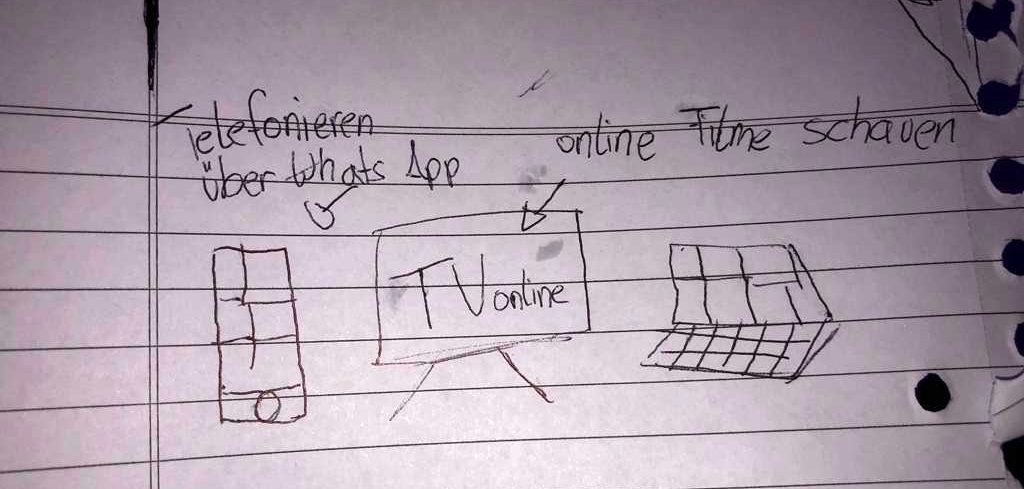
<p><img src="https://the.curlybracket.net/assets/images/blog/10-girl-AU.jpg" alt="A child's drawing. On the left, a smartphone with WhatsApp, saying 'calls with WhatsApp'. In the middle a TV saying 'watching movies'. On the right, a laptop with lots of open windowns." /></p>

<p>Her drawing shows how she uses the internet: calls using WhatsApp,
watching movies online, and a laptop with open windows on the screen.</p>

<p>She would ask the dragon that can explain one thing she always wanted to know about
the internet:</p>

<blockquote>
  <p>What is the internet? How does it work at all? How does it function?</p>
</blockquote>

<p>What she would change has to do with her earlier remark about stupid
things:</p>

<blockquote>
  <p>I would make it so that there are less stupid things. It would be good
to use the internet for better things, but not for useless things,
that one doesn’t actually need.</p>
</blockquote>

<p>When I asked her what she meant by “stupid things”, she replied:</p>

<blockquote>
  <p>Useless videos where one talks about nonsense. And one can also google
stupid things, for example “how long will i be alive?” and stuff like
that.</p>
</blockquote>

<h1 id="patterns">Patterns</h1>

<p>From the interviews I made until now, there seems to be a cut between
then age where kids don’t own a device and use the internet to watch
movies, series or listen to music and the age where they start owning a
device and then they start talking to their friends, and create accounts
on social media. This seems to happen roughly at ages 9-10.</p>

<p>I’m still surprised at the amount of ideas that kids have, when asked
what they would change on the internet if they could. I’m sure
there’s more if one goes looking for it.</p>

<h1 id="thanks">Thanks</h1>

<p>Thanks to my friends who made all these interviews possible either by
allowing me to meet their children, or their younger siblings: Anna,
Christa, Aline, Cindy, and Martina.</p>

<p>Read the next post in the series <a href="https://the.curlybracket.net/2022/05/23/internet-kids-pt3.html">Part 3</a></p>]]></content><author><name>curlybracket</name></author><summary type="html"><![CDATA[I wanted to understand how kids between 10 and 18 conceive the internet. I did some more interviews, and received a video recording of an interesting discussion.]]></summary></entry><entry><title type="html">How do kids conceive the internet?</title><link href="https://the.curlybracket.net/2022/03/31/internet-kids.html" rel="alternate" type="text/html" title="How do kids conceive the internet?" /><published>2022-03-31T00:00:00+02:00</published><updated>2022-03-31T00:00:00+02:00</updated><id>https://the.curlybracket.net/2022/03/31/internet-kids</id><content type="html" xml:base="https://the.curlybracket.net/2022/03/31/internet-kids.html"><![CDATA[<p>All parts of the series
Part 1
// <a href="https://the.curlybracket.net/2022/05/20/internet-kids-pt2.html">Part 2</a>
// <a href="https://the.curlybracket.net/2022/05/23/internet-kids-pt3.html">Part 3</a>
// <a href="https://the.curlybracket.net/2023/12/22/internet-kids-pt4.html">Part 4</a></p>

<p>I wanted to understand how kids between 10 and 18 conceive the internet.
Surely, we have seen a generation that we call “digital natives” grow up with
the internet. Now, there is a younger generation who grows up with pervasive
technology, such as smartphones, smart watches, virtual assistants and so on.
And only a few of them have parents who work in IT or engineering…</p>

<h1 id="pervasive-technology-contributes-to-the-idea-that-the-internet-is-immaterial">Pervasive technology contributes to the idea that the internet is immaterial</h1>

<p>With their search engine website design, Google has put in place an extremely
simple and straightforward user interface. Since then, designers and
psychologists have worked on making user interfaces more and more intuitive to
use. The buzzwords are “usability” and “user experience design”. Besides this
optimization of visual interfaces, haptic interfaces have evolved as well,
specifically on smartphones and tablets where hand gestures have replaced more
clumsy external haptic interfaces such as a mouse. And beyond interfaces, the
devices themselves have become smaller and slicker. While in our generation
many people have experienced opening a computer tower or a laptop to replace
parts, with the side effect of seeing the parts the device is physically
composed of, the new generation of end user devices makes this close to
impossible, essentially transforming these devices into black boxes, and
further contributing to the idea that the internet they are being used to
access with would be something entirely intangible.</p>

<h1 id="what-do-kids-in-2022-really-know-about-the-internet">What do kids in 2022 really know about the internet?</h1>

<p>So, what do kids of that generation really know about the internet, beyond
purely using services they do not control? In order to find out, I decided to
interview children between 10 and 18.</p>

<p>I conducted 5 interviews with kids aged 9, 10, 12, 15 and 17, two boys and
three girls. Two live in rural Germany, one in a German urban area, and two
live in the French capital.</p>

<p>I wrote the questions in a way to stimulate the interviewees to tell me a story
each time. I also told them that the interview is not a test and that there are
no wrong answers.</p>

<p>Except for the 9 year old, all interviewees possessed both, their own
smartphone and their own laptop. All of them used the internet mostly for
chatting, entertainment (video and music streaming, online games), social media
(TikTok, Instagram, Youtube), and instant messaging.</p>

<p>Let me introduce you to their concepts of the internet. That was my first story
telling question to them:</p>

<h1 id="if-aliens-had-landed-on-earth-and-would-ask-you-what-the-internet-is-what-would-you-explain-to-them">If aliens had landed on Earth and would ask you what the internet is, what would you explain to them?</h1>

<p>The majority of respondents agreed in their replies that the internet is
intangible – while still being a place where one “can do anything” and
“everything”.</p>

<p>Before I tell you more about their detailed answers to the above question, let
me show you how they visualize “their” internet.</p>

<h1 id="if-you-had-to-make-a-drawing-to-explain-to-a-person-what-the-internet-is-how-would-this-drawing-look-like">If you had to make a drawing to explain to a person what the internet is, how would this drawing look like?</h1>

<p>Each interviewee had some minutes to come up with a drawing.
As you will see, that drawing corresponds to what the kids would want an
alien to know about the internet and how they are using the internet
themselves.</p>

<h2 id="movies-series-videos">Movies, series, videos</h2>

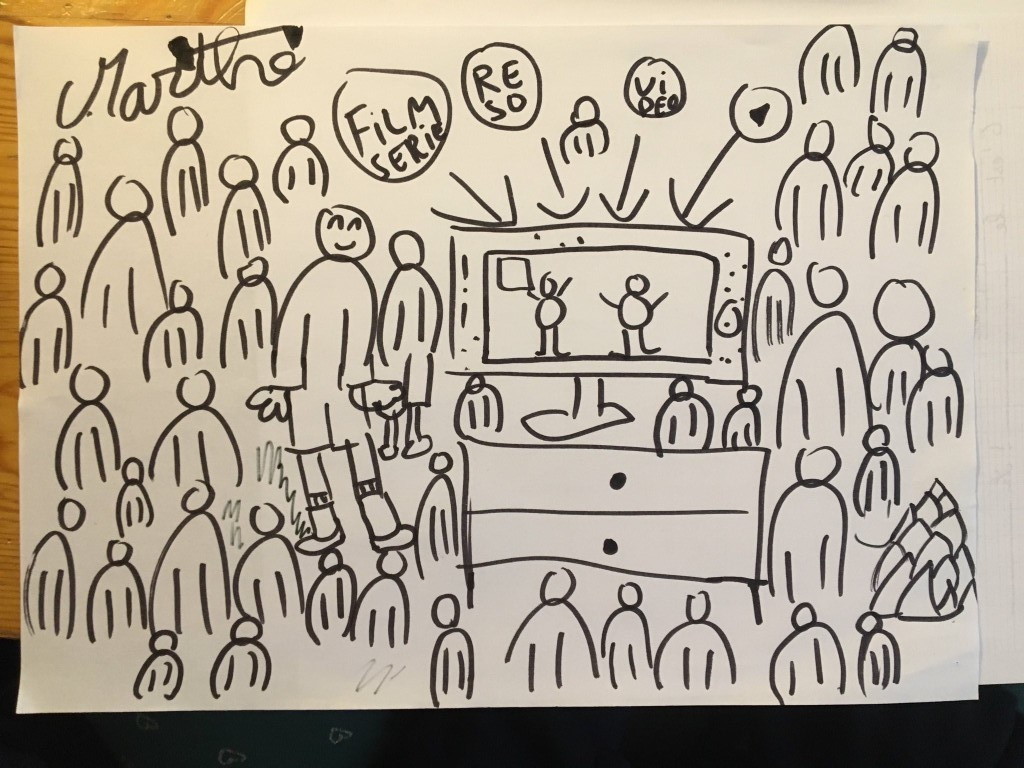
<p><img src="https://the.curlybracket.net/assets/images/blog/9-girl-FR.jpg" alt="A child's drawing. In the middle, there is a screen, on the screen a movie is running. Around the screen there are many people, at least two dozens. The words 'film', 'series', 'network', 'video' are written and arrows point from these words to the screen. There's also a play icon." /></p>

<p>The youngest respondent, a 9 year old girl, drew a screen with lots of people
around it and the words “film, series, network, video”, as well as a “play”
icon. She said that she mostly uses the internet to watch movies. She was the
only one who used a shared tablet and smartphone that belonged to her family,
not to herself. And she would explain the net like this to an alien:</p>

<blockquote>"Internet is a… er… one cannot touch it… it‘s an, er… [I propose
the word ‚idea‘], yes it‘s an idea. Many people use it not necessarily to
watch things, but also to read things or do other stuff."</blockquote>

<h2 id="user-interface-elements">User interface elements</h2>

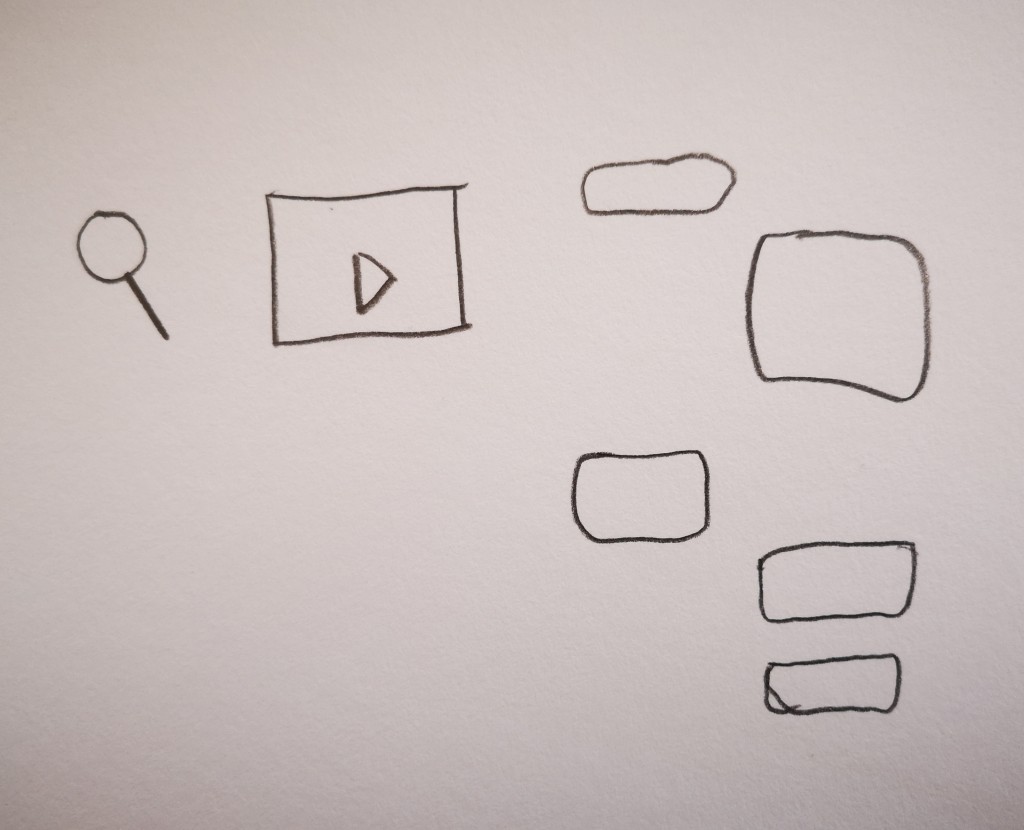
<p><img src="https://the.curlybracket.net/assets/images/blog/10-boy-DE.jpg" alt="There is a magnifying glass icon, a play icon and speech bubbles drawn with a pencil." /></p>

<p>A 10 year old boy represented the internet by recalling user interface
elements he sees every day in his drawing: a magnifying glass (search
engine), a play icon (video streaming), speech bubbles (instant
messaging). He would explain the internet like this to an alien:</p>

<blockquote>"You can use the internet to learn things or get information,
listen to music, watch movies, and chat with friends. You can do nearly
anything with it."</blockquote>

<h2 id="another-planet">Another planet</h2>

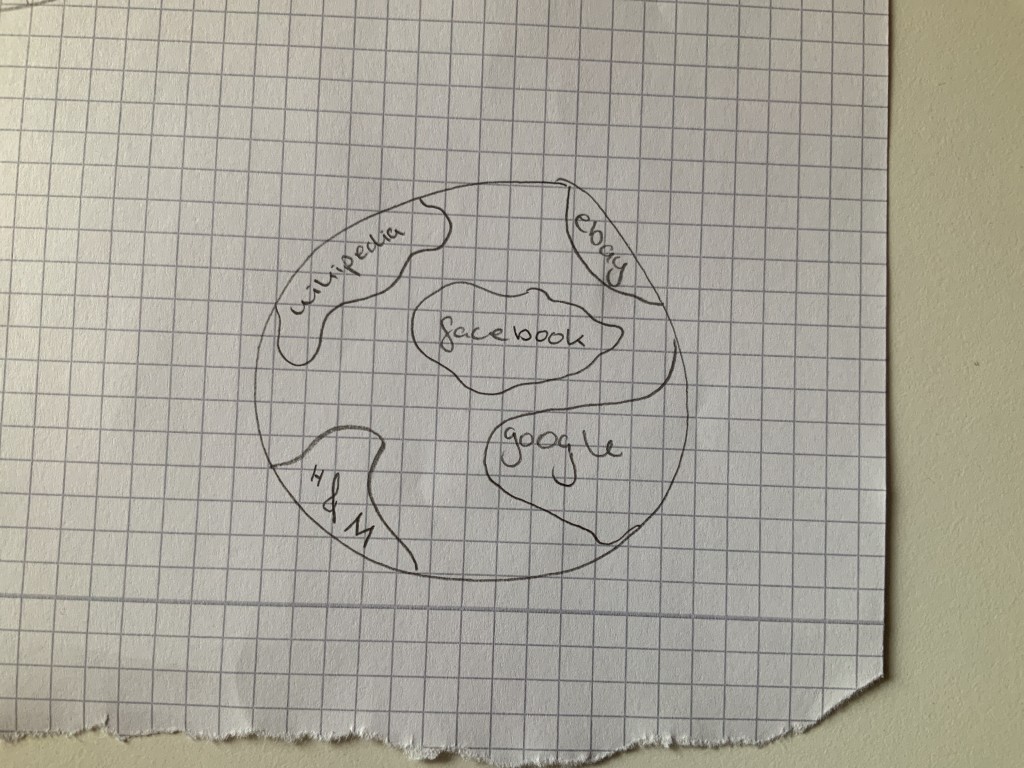
<p><img src="https://the.curlybracket.net/assets/images/blog/12-girl-DE.jpg" alt="Pencil drawing that shows a planet with continents. The continents are named: H&amp;M, Ebay, Google, Wikipedia, Facebook." /></p>

<p>A 12 year old girl imagines the internet like a second, intangible, planet
where Google, Wikipedia, Facebook, Ebay, or H&amp;M are continents that one enters
into.</p>

<blockquote>"And on [the] Ebay [continent] there‘s a country for clothes, and
,trousers‘, for example, would be a federal state in that
country."</blockquote>

<p>Something that was unique about this interview was that she told me she had an
email address but she never writes emails. She only has an email account to
receive confirmation emails, for example when doing online shopping, or when
registering to a service and needing to confirm one‘s address. This is
interesting because it‘s an anti-spam measure that might become outdated with a
generation that uses email less or not at all.</p>

<h2 id="home-network">Home network</h2>

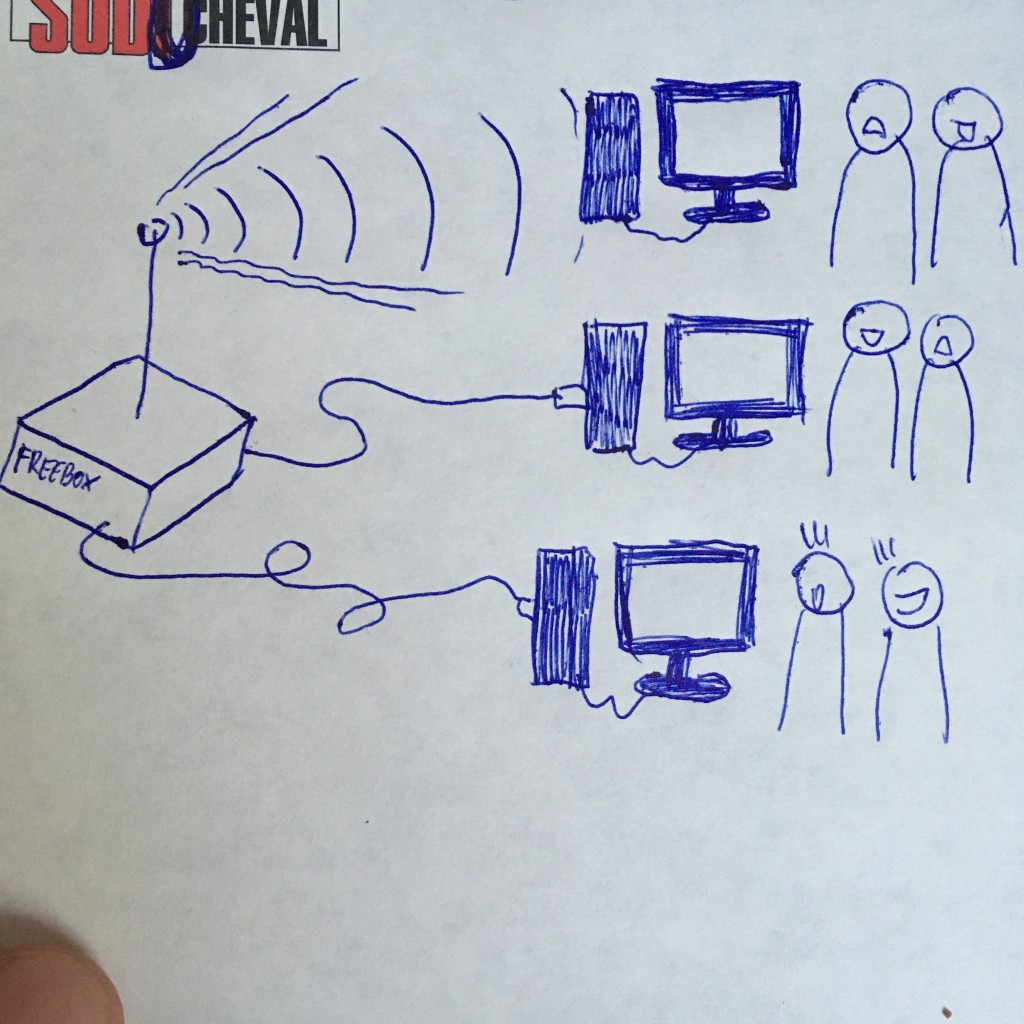
<p><img src="https://the.curlybracket.net/assets/images/blog/15-boy-FR.jpg" alt="Kid's drawing: there are three computer towers and next to each there are two people. The first couple is sad, the seconf couple is smiling, the last one is suprised. Each computer is connected to a router, two of them by cable, one by wifi." /></p>

<p>A 15 year old boy knew that his family‘s devices are connected to a home router
(Freebox is a router from the French ISP Free) but lacked an imagination of the
rest of the internet‘s functioning. When I asked him about what would be behind
the router, on the other side, he said what‘s behind is like a black hole to
him. However, he was the only interviewee who did actually draw cables, wifi
waves, a router, and the local network. His drawing is even extremely precise,
it just lacks the cable connecting the router to the rest of the internet.</p>

<h2 id="satellite-internet">Satellite internet</h2>

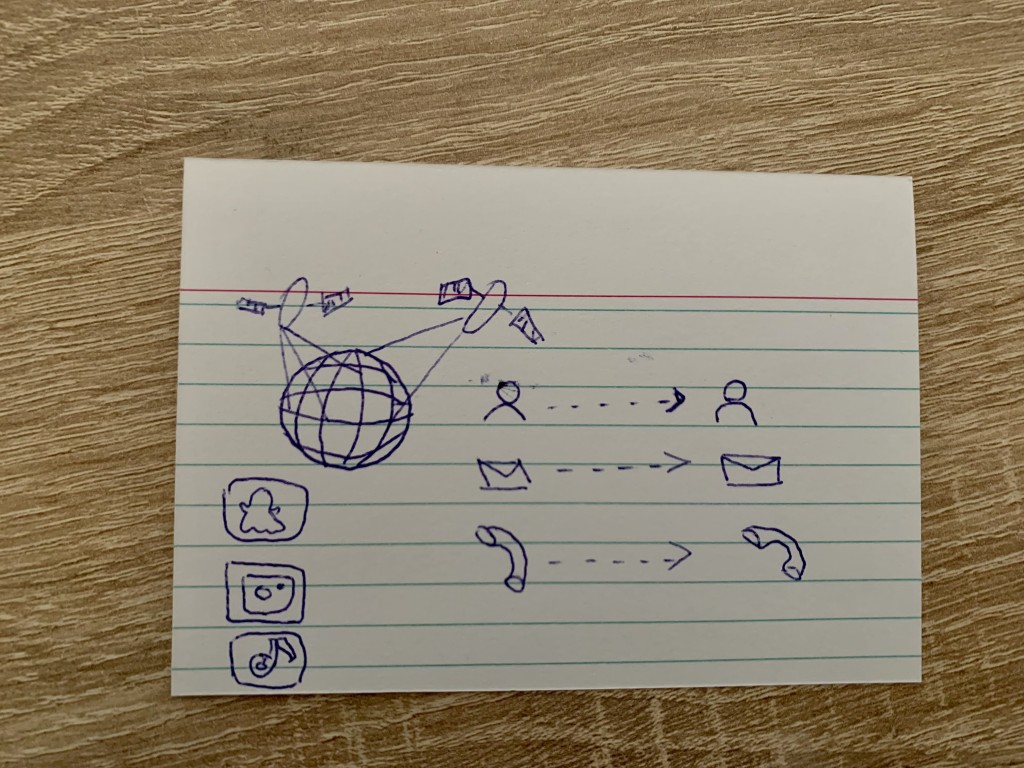
<p><img src="https://the.curlybracket.net/assets/images/blog/17-girl-DE.jpg" alt="This is another very simple drawing: On top left, there's planet Earth an there are lines indicating that earth is a sphere. Around Earth there are two big satellites reaching most of Earth. on the left, below, there are three icons representing social media services on the internet: Snapchat, Instagram, TikTok. On the right, there are simplified drawings of possibilities which the internet offers: person to person connection, email (represented by envelopes), calls (represented by an old-style telephone set)." /></p>

<p>A 17 year old girl would explain the internet to an alien as follows:</p>

<blockquote>"The internet goes around the entire globe. One is networked with
everyone else on Earth. One can find everything. But one cannot touch the
internet. It‘s like a parallel world. With a device one can look into the
internet. With search engines, one can find anything in the world, one can
phone around the world, and write messages. [The internet] is a gigantic
thing."</blockquote>

<p>This interviewee stated as the only one that the internet is huge. And
while she also is the only one who drew the internet as actually having
some kind of physical extension beyond her own home, she seems to
believe that internet connectivity is based on satellite technology and
wireless communication.</p>

<h1 id="imagine-that-a-wise-and-friendly-dragon-could-teach-you-one-thing-about-the-internet-that-youve-always-wanted-to-know-what-would-you-ask-the-dragon-to-teach-you-about">Imagine that a wise and friendly dragon could teach you one thing about the internet that you’ve always wanted to know. What would you ask the dragon to teach you about?</h1>

<p>A 10 year old boy said he‘d like to know “how big are the servers behind all of
this”. That‘s the only interview in which the word “server” came up.</p>

<p>A 12 year old girl said “I would ask how to earn money with the internet. I
always wanted to know  how this works, and where the money comes from.” I love
the last part of her question!</p>

<p>The 15 year old boy for whom everything behind the home router is out of his
event horizon would ask “How is it possible to be connected like we are? How
does the internet work scientifically?”</p>

<p>A 17 year old girl said she‘d like “to learn how the darknet works, what hidden
things are there? Is it possible to get spied on via the internet? Would it be
technically possible to influence devices in a way that one can listen to
secret or telecommanded devices?”</p>

<p>Lastly, I wanted to learn about
what they find annoying, or problematic about the internet.</p>

<h1 id="imagine-you-could-make-the-internet-better-for-everyone-what-would-you-do-first">Imagine you could make the internet better for everyone. What would you do first?</h1>

<p>Asked what she would change if she could, the 9 year old girl advocated for a
global usage limit of the internet in order to protect the human brain.
Also, she said, her parents spend way too much time on their phones and people
should rather spend more time with their children.</p>

<p>Three of the interviewees agreed that they see way too many advertisements and
two of them would like ads to disappear entirely from the web. The other one
said that she doesn‘t want to see ads, but that ads are fine if she can at
least click them away.</p>

<p>The 15 year old boy had different ambitions. He told me he would change:</p>

<blockquote>"the age of access to the internet. More and more younger people
access the internet ; especially with TikTok there is a recommendation
algorithm that can influcence young people a lot. And influencing young
people should be avoided but the internet does it too much. And that can be
negative. If you don‘t yet have a critical spirit, and you watch certain
videos you cannot yet moderate your stance. It can influence you a lot.
There are so many things that have become indispensable and that happen on
the internet and we have become dependent. What happens if one day it
doesn‘t work anymore? If we connect more and more things to the net, that‘s not
a good thing."</blockquote>

<h1 id="the-internet---oh-thats-what-you-mean">The internet - Oh, that’s what you mean!</h1>

<p>On a sidenote, my first interview tentative was with an 8 year old girl
from my family.  I asked her if she uses the internet and she denied, so
I abandoned interviewing her. Some days later, while talking to her, she
proposed to look something up on Google, using her smartphone.  I said:
“Oh, so you <strong>are</strong> using the internet!” She replied: “Oh, <strong>that‘s</strong>
what you‘re talking about?”</p>

<p>I think she knows the word “Google” and she knows that she can search
for information with this Google thing.  But it appeared that she
doesn‘t know that the Google search engine is located somewhere else on
internet and not on her smartphone.  I concluded that for her, using the
services on the smartphone is as “natural” as switching on a light in
the house: we also don’t think about where the electricity comes from
when we do that.</p>

<h1 id="what-can-we-learn-from-these-few-interviews">What can we learn from these few interviews?</h1>

<p>Unsurprisingly, social media, streaming, entertainment, and instant messaging
are the main activities kids undertake on the internet. They are completely at
the mercy of advertisements in apps and on websites, not knowing how to get rid
of them. They interact on a daily basis with algorithms that are unregulated
and known to perpetuate discrimination and to create filter bubbles, without
necessarily being aware of it. The kids I interviewed act as mere service users
and seem to be mostly confined to specific apps or websites.</p>

<p>All of them perceived the internet as being something intangible. Only the
older interviewees perceived that there must be some kind of physical expansion
to it: the 17 year old girl by drawing a network of satellites around the
globe, the 15 year old boy by drawing the local network in his home.</p>

<p>Read the next post in the series <a href="https://the.curlybracket.net/2022/05/20/internet-kids-pt2.html">Part 2</a></p>]]></content><author><name>curlybracket</name></author><summary type="html"><![CDATA[I wanted to understand how kids between 10 and 18 conceive the internet. Surely, we have seen a generation that we call 'digital natives' grow up with the internet. Now, there is a younger generation who grows up with pervasive technology, such as smartphones, smart watches, virtual assistants and so on. And only a few of them have parents who work in IT or engineering…]]></summary></entry><entry><title type="html">Workshops about anger, saying NO, and mapping one’s capacities and desires</title><link href="https://the.curlybracket.net/2022/03/23/workshops.html" rel="alternate" type="text/html" title="Workshops about anger, saying NO, and mapping one’s capacities and desires" /><published>2022-03-23T00:00:00+01:00</published><updated>2022-03-23T00:00:00+01:00</updated><id>https://the.curlybracket.net/2022/03/23/workshops</id><content type="html" xml:base="https://the.curlybracket.net/2022/03/23/workshops.html"><![CDATA[<p>For the second year in a row, I proposed some workshops at the feminist
hackers assembly at the remote C3. I’m sharing them here because I
believe they might be useful to others.</p>

<h2 id="anger-workshop">Anger workshop</h2>

<p>Based on my readings about the subject and a mediation training, I
created a first workshop about dealing with one’s own anger for the
feminist hackers assembly in 2020.  Many women who attended said they
recognized themselves in what I was talking about. I created the
exercises in the workshop with the goal of getting participants to share
and self-reflect in small groups.  I’m not giving out solutions, instead
proposals on how to deal with anger come from the participants
themselves. (I added the last two content pages to the file after the
workshop.) This is why this workshop is always different, depending on
the group and what they want to share. The first time I did
this workshop was a huge success and so I created an improved version
for the assembly of 2021.</p>

<p>→ <a href="https://curlybracket.net/assets/files/angry-womxn-workshop-rc3-2021.pdf">Angry
womxn* workshop</a></p>

<h2 id="the-act-of-saying-no">The act of saying NO</h2>

<p>We often say yes, despite wanting to say no, out of a sense of duty, or
because we learned that we should always be nice and helpful, and that
our own needs are best served last. Many people don’t really know how to
say no. Sarah Cooper, a former Google employee herself, makes fun of
this in her fabulous book “How to Be Successful Without Hurting Men’s
Feelings” (highly recommended read!):</p>

<p><img src="https://cms.qz.com/wp-content/uploads/2018/11/Screen-Shot-2018-11-11-at-8.19.31-PM-e1541996436170.png" alt="A drawing of a woman who says: How I say yes: I'd love to. How I say no: sure." /></p>

<p>That’s why a discussion space about saying NO did not seem out of place
at the feminist hackers assembly :) I based my workshop on the original,
created by the Institute of War and Peace Reporting and distributed
through their holistic security training manual.</p>

<p>I like this workshop because sharing happens in a small groups and has
an immediately felt effect. Several people reported that the exercises
allowed them to identify the exact moment when they had said yes to
something despite really having wanted to say no. The exercises from the
workshop can easily be done with a friend or trusted person, and they
can even be done alone by writing them down, although the effect in
writing might be less pronounced.</p>

<p>→ <a href="https://curlybracket.net/assets/files/the-act-of-no-workshop-rc3-2021.pdf">The
act of saying NO workshop</a></p>

<h2 id="mapping-capacities-and-desires">Mapping capacities and desires</h2>

<p>Based on discussions with a friend, whose company uses SWOT analysis
(strengths—weaknesses—opportunities—threats) to
regularly check in with their employees, and to allow employees to check
in with themselves, I created a similar tool for myself which I thought
would be nice to share with others. It’s a very simple self-reflection
that can help map out what works well, what doesn’t work so well and
where one wants to go in the future. I find it important to not use this
tool narrow-mindedly only regarding work skills and expertise. Instead,
I think it’s useful to also include soft skills, hobbies, non-work
capacities and whatever else comes to mind in order to create a truer
map.</p>

<p>Fun fact: During the assembly, a bunch of participants reported that
they found it hard to distinguish between things they don’t like doing
and things they don’t know how to do.</p>

<p>→ <a href="https://curlybracket.net/assets/files/mapping-capacities-desires-workshop-rc3-2021.pdf">Mapping
capacities and desires</a></p>

<h2 id="known-issues">Known issues</h2>

<p>One important feedback point I got is that people felt the time for the
exercises in all three workshops could have been longer. In case you
want to try out these workshops, you might want to take this into
account.</p>]]></content><author><name>curlybracket</name></author><summary type="html"><![CDATA[For the second year, I proposed some workshops at the feminist hackers assembly at the remote C3 last December.]]></summary></entry><entry><title type="html">On anger, misunderstandings, and hearing with different ears</title><link href="https://the.curlybracket.net/2021/02/05/anger-4-sides-message.html" rel="alternate" type="text/html" title="On anger, misunderstandings, and hearing with different ears" /><published>2021-02-05T00:00:00+01:00</published><updated>2021-02-05T00:00:00+01:00</updated><id>https://the.curlybracket.net/2021/02/05/anger-4-sides-message</id><content type="html" xml:base="https://the.curlybracket.net/2021/02/05/anger-4-sides-message.html"><![CDATA[<h2 id="anger">Anger</h2>

<p>Anger is a feeling that is mostly taboo in our society. People tend to
think that anger and rage are the same thing and reject anger. We are
taught to suppress it.  But: “The suppression of anger can cause a lot
of trouble, giving rise to virulent progeny such as malice, passive
aggression, hostility, rage, sabotage, hate, blame, guilt, controlling
behavior, shame, self-blame, and self-destruction.” (Quoted from: Anne
Katherine, “Where to draw the line”).</p>

<p>When we talk about anger, we need to distinguish between acting
out anger, and feeling anger. In general, when you hear me talking about
anger, I’m talking about the <strong>feeling</strong> named <em>anger</em> in English.</p>

<p>Anger is a normal feeling with a super power: it gives us the energy to
change a situation that we consider to be unsustainable.  We can express
the feeling of anger verbally by saying for example: “That thing makes
me really angry”, “I can’t talk right now, I am very angry about what I
just heard”.</p>

<p>Let’s also note that <a href="https://www.gottman.com/blog/the-anger-iceberg/">there may be other feelings lying below
anger</a>, such as
sadness, frustration, grief, fear, etc.</p>

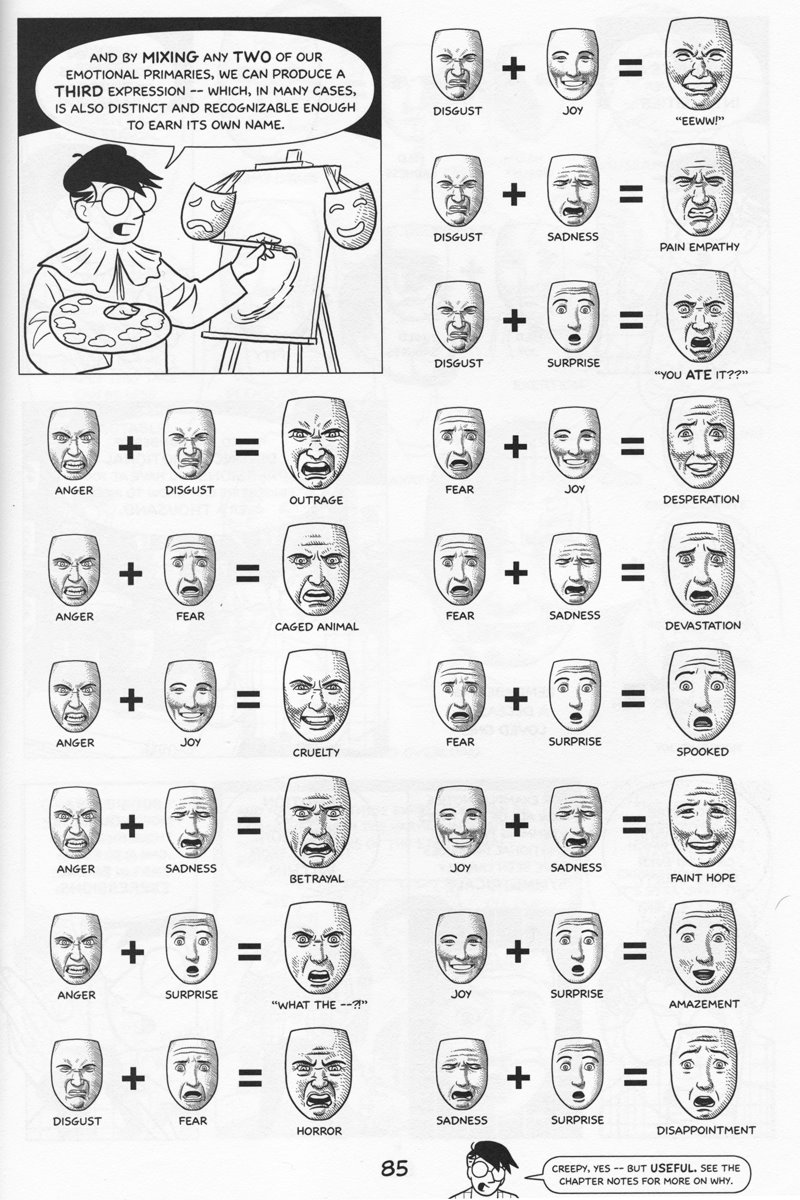
<p><img src="/assets/images/blog/scottmccloud.jpg" alt="Mixing emotions" /></p>

<p>This is a page from the wonderful <a href="https://en.wikipedia.org/wiki/Making_Comics">“Making Comics” by Scott
McCloud</a>.
(Yes, emotions are complex! See some more of <a href="https://www.jeremyshuback.com/blog/the-six-fundamental-facial-expressions">Scott McCloud’s pages about emotion in comics</a>)</p>

<h2 id="bottling-up-feelings">Bottling up feelings</h2>

<p>Most of the time, people don’t get angry suddenly, even though it might
seem like that from the outside. Instead, they’ve been bottling up
feelings for a while, and at some point, a small trigger is enough to
make the bottle overflow. The reasons for bottling up feelings can be as
diverse as people:</p>

<ul>
  <li>Low self-esteem: not thinking one has the right and the capacity to
express unpleasant feelings</li>
  <li>Not knowing how to express unpleasant feelings. For example not having
learnt to say: “I am not comfortable, I’ll leave now, I’ll get back to
you once I know what’s going on / if this is about me / if I feel like
it.”</li>
  <li>Not trusting one’s own feelings, specifically common in people who
have been <a href="https://www.rewriting-the-rules.com/conflict-break-up/gaslighting-and-consent/">victims of gaslighting</a></li>
  <li>Repressing emotions, specifically anger, sometimes to the
point of not being able to feel one’s own feelings anymore</li>
  <li>Not being able to express disagreement and instead applying the <em>fawn</em>
response: trying to please the other in order to avoid further
conflict. See: <a href="https://www.psychologytoday.com/us/blog/addiction-and-recovery/202008/understanding-fight-flight-freeze-and-the-fawn-response">Fight, flight, freeze, or
fawn</a></li>
  <li>Not being able to express boundaries: “stop”, “this is enough”, “I
don’t accept this”, etc.</li>
  <li>Not being in a situation or a space in which feelings can be expressed
freely, for example a workplace or a hierarchical situation where this
might be disadvantageous</li>
</ul>

<p>These are just some examples I can come up with in 3 minutes, the list
is non exhaustive.</p>

<p>When someone’s bottle overflows, their peers can be confused and not
know how to react to what they perceive as a sudden outburst —
while what they are seeing might just be the other person’s first time
tentative of saying “no” or “stop”. Oftentimes, the responsibility for
the situation is then put on the shoulders of the person who supposedly
“exploded”: they have been behaving differently than usual or not within
the expectations, right?</p>

<p>Well, it’s not that simple. Conflicts are relational. The other party might have
ignored signs, requests, feelings, and needs of the angry person for a
while. Maybe the relationship has been deteriorating since some time?
Maybe there was a power imbalance, that has never been revisited,
updated, questioned? Or maybe their bottle is being filled by something
else in their life and getting too small to contain all the drops of
suppressed emotions. People change, and relationships change. We cannot
assume that because a person has accepted something for months or years,
that they always will. I think that anger can be a sign of such change
or need thereof.</p>

<h2 id="a-message-has-four-sides-and-that-creates-misunderstandings">A message has four sides… and that creates misunderstandings</h2>

<p><a href="https://en.wikipedia.org/wiki/Friedemann_Schulz_von_Thun">Friedemann Schulz von
Thun</a> has
created a theory, the <a href="https://en.wikipedia.org/wiki/Four-sides_model">four-sides
model</a>, that establishes
four facets of a message:</p>

<ul>
  <li>Fact: What is the message about?</li>
  <li>Self-disclosure: What does the speaker reveal about
herself (with or without intention)?</li>
  <li>Relation: What is the speaker’s relationship
towards the receiver of the message?</li>
  <li>Appeal: What does the speaker want to obtain?</li>
</ul>

<p>Let me adapt Schulz von Thun’s example to a situation that happened to
me once: I came to a friend’s house and I smelled some unknown thing
when I entered the apartment. I asked: <em>“what’s that smell?”</em> I actually
never bake, so I don’t know anything about whatever it is people put
into cakes. I wanted to say: I don’t know what that smell is, tell me
what it is? She replied: <em>“You never like anything I do, my furniture
gets criticized, my cake’s not right, and you criticize me all the
time.”</em> We ended up in such a big misunderstanding that I left her house
5 minutes after I arrived.</p>

<p>With Schulz von Thun’s model we can understand what happened here:</p>

<p>The speaker’s question <em>“What’s that smell in the kitchen?”</em> has four
sides:</p>

<ol>
  <li>Factual: There is a smell.</li>
  <li>Self-disclosure: I don’t know what it is.</li>
  <li>Relational: You know what it is.</li>
  <li>Appeal: Tell me what it is!</li>
</ol>

<p>The receiver can hear the question with 4 different ears:</p>

<ol>
  <li>Factual part: There is a smell.</li>
  <li>Self-disclosure: I don’t like the smell.</li>
  <li>Relationship: You’re not good at baking cake.</li>
  <li>Appeal: Don’t bake cake anymore.</li>
</ol>

<p>At this point, the receiver will probably reply: “Bake the cake yourself next time!”</p>

<h2 id="behind-the-message">Behind the message</h2>

<p>Sometimes, we hear more strongly with one ear than with the other ears.
For example, some people hear more on the relational side and they will
always hear “You’re not good at …”. Other people hear more on the appeal
side and will always try to guess into a message what the other person
wants or expects of them. People on the autistic spectrum often hear
better with the factual ear, and do not understand the other layers of
the message.</p>

<h2 id="form-and-contents-of-a-message">Form and contents of a message</h2>

<p>Getting back to anger, I think that it’s often not the contents —
i.e. the factual facet — of a message that triggers our bottle to
overflow, but the (perceived) intention of the speaker, i.e. the appeal
facet.</p>

<p>For example, a speaker might have an intention to silence us by using
gaslighting, or <a href="https://www.robot-hugs.com/2016/01/tone-policing/">tone
policing</a>. Or a
speaker wants to explicitly hurt us because that’s how they learnt to
deal with their own feelings of hurt.</p>

<p>The actual relation between speaker and receiver also seems to play a
role in how anger can get triggered, when we hear with the relational
ear. There are many nonverbal underlying layers to our communication:</p>

<ul>
  <li>The position of both speaker and receiver to each other: are they
equals or is there any kind of power imbalance between them? A power
imbalance can be a (perceived) dependency: For example, one person in
a friendship has a kid and the other one regularly helps them so that
the parent has some time to advance their work or career: this can
create a feeling of not being good enough by oneself and having to
rely on others. Or there is indeed a dependency in which the speaker
is a team lead and the receiver a subordinate.</li>
  <li>The needs of each person: a need to solve problems quickly for one
person might conflict with the need to be involved in decision making
of the other person. (See <a href="http://changingminds.org/explanations/motivation/kahler_drivers/kahlers_drivers.htm">Taibi Kahler’s
drivers</a>)</li>
  <li>The inner beliefs of each person: in childhood we might have
constructed the <a href="https://en.wikipedia.org/wiki/Inner_child">inner
belief</a>: <a href="https://www.youtube.com/watch?v=B9NDIwOqnys">“You’re okay, I’m
not okay”</a>, or “Nobody
cares about what I want”, or “I have to be nice (friendly,
hardworking, strong, etc.) all the time otherwise nobody loves me” -
as some examples.</li>
</ul>

<p>So, suppose person A offers to help person B, and what person B hears
instead is their overprotective mother instead of their friend. Person
A might be surprised to see B overreact or disappear for a while to
get back their feelings of autonomy and integrity as an adult.</p>

<p>Or person C expresses she’d “like to handle problem X like this” while
person D might well not hear this as a proposal to handle a problem, but
as a decision made without involving her. Which might propel D back to
her childhood in which she could also not take decisions autonomously.
Then D might react like she would react as a child, slamming a door,
shout, run away, freeze, or fawn.</p>

<h2 id="communication-is-complex">Communication is complex!</h2>

<p>So, whenever we hear a message, not only do we hear the message with <em>four
ears</em>, but also, we hear it with our position, our needs, and our inner
beliefs. And sometimes, our bottle is already full, and then it
overflows.</p>

<p>At that point, I find it important that both sides reflect on the
situation and stay in contact. Using empathy and compassion, we can try
to better understand what’s going on, where we might have hurt the other
person, for example, or  what was being misunderstood. Did we hear only
one side of the message? Do our respective strategies conflict with each
other?</p>

<p>If we cannot hear each other anymore or always hear only one side of the
message, we can try to do a mediation. Obviously, if at that point one
side does not actually want to solve the problem, or thinks it’s not
their problem, then there’s not much we can do, and mediation would not
help.</p>

<p>The examples above might sound familiar to you. I chose them because
I’ve seen them happen around me often, and I understand them as shared
patterns. While all beings on this planets are unique, we share a common
humanity, for example through such patterns and common experiences.</p>]]></content><author><name>curlybracket</name></author><summary type="html"><![CDATA[When misunderstandings arise, it's often because messages can be heard with different ears. When anger seemingly suddenly bursts out, it could be that feelings have been bottled up for a while.]]></summary></entry><entry><title type="html">Better handling emergencies</title><link href="https://the.curlybracket.net/2020/10/30/emergencies.html" rel="alternate" type="text/html" title="Better handling emergencies" /><published>2020-10-30T00:00:00+01:00</published><updated>2020-10-30T00:00:00+01:00</updated><id>https://the.curlybracket.net/2020/10/30/emergencies</id><content type="html" xml:base="https://the.curlybracket.net/2020/10/30/emergencies.html"><![CDATA[<p>We all know these situations when we receive an email asking <em>Can you
check the design of X, I need a reply by tonight.</em> Or an instant
message: <em>My website went down, can you check?</em> Another email: <em>I
canceled a plan at the hosting company, can you restore my website as
fast as possible?</em> A phone call: <em>The TLS certificate didn’t get
updated, and now we can’t access service Y.</em> Yet another email: <em>Our
super important medical advice website is suddenly being censored in
country Z, can you help?</em></p>

<p>Everyone knows those messages that have “URGENT” in capital letters in
the email subject. It might be that some of them really are urgent.
Others are the written signs of someone having a hard time properly
planning their own work and passing their delays on to someone who comes
later in the creation or production chain. And others again come from
people who are overworked and try to delegate some of their tasks to a
friendly soul who is likely to help.</p>

<h2 id="how-emergencies-create-more-emergencies">How emergencies create more emergencies</h2>

<p>In the past, my first reflex when I received an urgent request was to
start rushing into solutions. This happened partly out of empathy,
partly because I like to be challenged into solving problems, and I’m
fairly good at that. This has proven to be unsustainable, and here is
why.</p>

<h3 id="emergencies-create-unplanned-work">Emergencies create unplanned work</h3>

<p>The first issue is that emergencies create a lot of <strong>unplanned work</strong>.
Which in turn means not getting other, scheduled, things done. This can
create a backlog, end up in working late, or working on weekends.</p>

<h3 id="emergencies-can-create-a-permanent-state-of-exception">Emergencies can create a permanent state of exception</h3>

<p>Unplanned work can also create a lot of frustration, out of the feeling of
not getting the things done that one planned to do. We might even get a
feeling of being nonautonomous (in German I would say <em>fremdbestimmt</em>,
which roughly translates to “being directed by others”).</p>

<p>On the long term, this can generate unsustainable situations: higher
work loads, and burnout. When working in a team of several people, A
might have to take over the work of B because B has not enough
capacities. Then A gets overloaded in turn, and C and D have to take
over A’s work. Suddenly the team is stuck in a permanent state of
exception. This state of exception will produce more backlog. The team
might start to deprioritize social issues over getting technical things
done. They might not be able to recruit new people anymore because they
have no capacity left to onboard newcomers.</p>

<h3 id="one-emergency-can-result-in-a-variety-of-emergencies-for-many-people">One emergency can result in a variety of emergencies for many people</h3>

<p>The second issue produced by urgent requests is that if I cannot solve
the initial emergency by myself, I might try to involve colleagues,
other people who are skilled in the area, or people who work in another
relevant organization to help with this. Suddenly, the initial emergency
has become my emergency as well as the emergency of a whole bunch of
other people.</p>

<h3 id="a-sidenote-about-working-with-friends">A sidenote about working with friends</h3>

<p>This might be less of an issue in a classical work setup than in a
situation in which a bunch of freelancers work together, or in setups in
which work and friendships are intertwined. This is a problem, because
the boundaries between friend and worker role, and the expectations that
go along with these roles, can get easily confused. If a colleague asks
me to help with task X, I might say no; if a friend asks, I might be
less likely to say no.</p>

<h2 id="what-i-learnt-about-handling-emergencies">What I learnt about handling emergencies</h2>

<p>I came up with some guidelines that help me to better handle
emergencies.</p>

<h3 id="plan-for-unplanned-work">Plan for unplanned work</h3>

<p>It doesn’t matter and it doesn’t help to distinguish if urgent requests
are legitimate or if they come from people who have not done their
homework on time.</p>

<p>What matters is to make one’s weekly todo list sustainable. After
reading <a href="https://ddegrandis.com/book/"><em>Making work visible</em> by Domenica de
Grandis</a>, I understood the need to add
free slots for unplanned work into one’s weekly schedule. Slots for
unplanned work can take up to 25% of the total work time!</p>

<h3 id="take-time-to-make-plans">Take time to make plans</h3>

<p>Now that there are some free slots to handle emergencies, one can take
some time to think when an urgent request comes in. A German saying
proposes to <a href="https://www.girlgeniusonline.com/comic.php?date=20160422"><em>wait and have some tea</em> (“abwarten und Tee
trinken”)</a>. I
think this is actually really good advice, and works for any non-obvious
problem. Sit down and let the situation sink in. Have a tea, take a
shower, go for a walk. It’s never that urgent. Really, never. If
possible, one can talk about the issue with another person, <a href="https://en.wikipedia.org/wiki/Rubber_duck_debugging">rubberduck
style</a>. Then one
can make a plan on how to address the emergency properly, it could be
that the solution is easier than at first thought.</p>

<h3 id="affirming-boundaries-saying-no">Affirming boundaries: Saying no</h3>

<p>Is the emergency that I’m asked to solve really my problem? Or is
someone trying to involve me because they know I’m likely to help? Take
a deep breath and think about it. No? It’s not my job, not my role? I
have no time for this right now? I don’t want to do it?  Maybe I’m not
even paid for it? A colleague is pushing my boundaries to get some task
on their own todo list done? Then I might want to say no. <em>I can’t help
with this.</em> or <em>I can help you in two weeks.</em> I don’t need to give a
reason. <em>No.</em> is a sentence. And: <a href="https://ddegrandis.com/saying-no-doesnt-make-you-an-arse/">Saying no doesn’t make me an
arse.</a></p>

<h3 id="affirming-boundaries-clearly-defining-ones-role">Affirming boundaries: Clearly defining one’s role</h3>

<p>Clearly defining one’s role is something that is often overlooked. In
many discussions I have with friends it appears that this is a major
cause of overwork and underpayment. Lots of people are skilled,
intelligent, and curious, and easily get challenged into putting on
their super hero dress. But they’re certainly <strong>not the only person</strong>
that can help—even if an urgent request makes them think that at
first.</p>

<p>To clearly define our role, we need to make clear which part of the job
is our work, and which part needs to be done by other people. We should
stop trying to accomodate people and their requests to the detriment of
our own sanity. You’re a language interpreter and are being asked to
mediate a bi-lingual conflict between the people you are interpreting
for?  It’s not your job. You’re the graphic designer for a poster, but
the text you’ve been given is not good enough? Send back a
recommendation to change the text; don’t do these changes yourself: it’s
not your job. But you can and want to do this yourself and it would make
your client’s life easier? Then ask them to get paid for the extra time,
and make sure to renegotiate your deadline!</p>

<h3 id="affirming-boundaries-defining-expectations">Affirming boundaries: Defining expectations</h3>

<p>Along with our role, we need to <em>define expectations</em>: in which
timeframe am I willing to do the job?  Under which contract, which
agreement, which conditions? For which payment?</p>

<p>People who work in a salary office job generally do have a work contract
in which their role and the expectations that come with this role are
clearly defined.  Nevertheless, I hear from friends that their superiors
regularly try to make them do tasks that are not part of their role
definition. So, here too, role and expectations sometimes need to be
renegotiated, and the boundaries of these roles need to be clearly
affirmed.</p>

<h2 id="random-conclusive-thoughts">Random conclusive thoughts</h2>

<p>If you’ve read until here, you might have experienced similar things.</p>

<p>Or, on the contrary, maybe you’re already good at communicating your
boundaries and people around you have learnt to respect them?
Congratulations.</p>

<p>In any case, for improving one’s own approach to such requests, it can
be useful to find out <a href="https://www.enricozini.org/blog/2020/debian/doing-things-together/">which inner dynamics are at play when we interact
with other
people</a>.
Additionally, it can be useful to understand the differences between
<a href="https://www.theguardian.com/lifeandstyle/2010/may/08/change-life-asker-guesser">Asker and Guesser
culture</a>:</p>

<blockquote>
  <p>when an Asker meets a Guesser, unpleasantness results. An Asker won’t
think it’s rude to request two weeks in your spare room, but a Guess
culture person will hear it as presumptuous and resent the agony
involved in saying no. Your boss, asking for a project to be finished
early, may be an overdemanding boor – or just an Asker, who’s assuming
you might decline. If you’re a Guesser, you’ll hear it as an
expectation.</p>
</blockquote>

<p>Askers should also be aware that there might be Guessers in their team.
It can help to define clear guidelines about making requests (when do I
expect an answer, under which budget/contract/responsibility does the
request fall, what other task can be put aside to handle the urgent
task?) Last, but not least, <a href="https://ddegrandis.com/book/"><em>Making work
visible</em></a> has a lot of other proposals on
how to visibilize and then deal with unplanned work.</p>]]></content><author><name>curlybracket</name></author><summary type="html"><![CDATA[Everyone working with a computer knows those messages that have URGENT in capital letters in the email subject. What I learnt about dealing with emergencies.]]></summary></entry><entry><title type="html">Code reviews: from nitpicking to cooperation</title><link href="https://the.curlybracket.net/2020/08/24/nitpicking.html" rel="alternate" type="text/html" title="Code reviews: from nitpicking to cooperation" /><published>2020-08-24T07:15:00+02:00</published><updated>2020-08-24T07:15:00+02:00</updated><id>https://the.curlybracket.net/2020/08/24/nitpicking</id><content type="html" xml:base="https://the.curlybracket.net/2020/08/24/nitpicking.html"><![CDATA[<p>After we gave our talk at DebConf 20, <a href="https://www.enricozini.org/blog/2020/debian/doing-things-together/" target="_blank">Doing things together</a>,
there were 5 minutes left for the live Q&amp;A. Pollo asked a question that I
think is interesting and deserves a longer answer: <em>How can we still have a
good code review process without making it a "you need to be perfect"
scenario? I often find picky code reviews help me write better code.</em></p>

<p>I find it useful to first disentangle
what code reviews are good for, how we do them, why we do them that way, and
how we can potentially improve processes.</p>

<h3>What are code reviews good for?</h3>

<p>Code review and peer review are great methods for cooperation aiming at:</p>

<ul>
    <li>Ensuring that the code works as intended</li>
    <li>Ensuring that the task was fully accomplished and no detail left out</li>
    <li>Ensuring that no security issues have been introduced</li>
    <li>Making sure the code fits the practices of the team and is understandable and maintainable by others</li>
    <li>Sharing insights, transferring knowledge between code author and code reviewer</li>
    <li>Helping the code author to learn to write better code</li>
</ul>
<p>Looking at this list, the last point seems to be more like a nice side
effect of all the other points. :)</p>

<h3>How do code reviews happen in our communities?</h3>

<p>It seems to be a common assumption that code reviews are&mdash;and have to
be&mdash;picky and perfectionist. To me, this does not actually seem to be a
necessity to accomplish the above mentioned goals. We might want to work with
<b>precision</b>&mdash;a quality which is different from perfection. Perfection
can hardly be a goal: perfection does not exist.</p>

<p>Perfectionist dynamics can lead to failing to call something "good enough"
or "done". Sometimes, a disproportionate amount of time is invested in writing
(several) code reviews for minor issues. In some cases, strong perfectionist
dynamics of a reviewer can create a feeling of never being good enough along
with a loss of self esteem for otherwise skilled code authors.</p>

<h3>When do we cross the line?</h3>

<p>When going from cooperation, precision, and learning to write better code,
to nitpicking, we are crossing a line: nitpicking means to pedantically search
for others' faults. For example, I once got one of my Git commits at work
criticized merely for its commit message that was said to be "ugly"
because I "use[d] the same word twice" in it.</p>

<p>When we are nitpicking, we might not give feedback in an appreciative,
cooperative way, we become fault finders instead. From there it's a short way
to operating on the level of blame.</p>

<p>Are you nitpicking to help or are you nitpicking to prove something?
Motivations matter.</p>

<h3>How can we improve code reviewing?</h3>

<p>When we <b>did</b> something wrong, we can do better next time. When we are told that we <b>are</b> wrong, the underlying assumption is that we cannot change (See Brené Brown, <a href="https://fs.blog/2014/10/brene-brown-guilt-shame/" target="_blank">The difference between blame and shame</a>). We can learn to go <a href="https://www.oreilly.com/library/view/beyond-blame/9781491914441/" target="_blank">beyond blame</a>.</p>

<p><a
 href="https://hbr.org/2018/01/negative-feedback-rarely-leads-to-improvement"
 target="_blank">Negative feedback rarely leads to improvement</a> if the
environment in which it happens lacks general appreciation and confirmation.
We can learn <a href="https://curlybracket.net/2020/03/08/feedback-culture.html"
target="_blank">to give helpful feedback</a>. It might be harder to create an
appreciative environment in which negative feedback is a possibility for
growth. One can think of it like of a relationship: in a healthy relationship
we can tell each other when something does not work and work it out&mdash;because
we regularly experience that we respect, value, and support each
other.</p>

<p>To be able to work precisely, we need guidelines, tools, and time. It's not
possible to work with precision if we are in a hurry, burnt out, or working
under a permanent state of exception. The same is true for receiving picky
feedback.</p>

<p>On DebConf's IRC channel, after our talk, marvil07 said: <em>On picky code
reviews, something that I find useful is automation on code reviews; i.e. when
a bot is stating a list of indentation/style errors it feels less personal, and
also saves time to humans to provide more insightful changes.</em> Indeed, we can
set up routines that do automatic fault checking (<a
href="https://en.wikipedia.org/wiki/Lint_(software)"
target="_blank">linting</a>). We can set up coding
guidelines. We can define what we call "done" or "good enough".</p>

<p>We can negotiate with each other how we would like code to be reviewed. For
example, one could agree that a particularly perfectionist reviewer should
point out only functional faults. They can spare their time and refrain from
writing lengthy reviews about minor esthetic issues that have never made it
into a guideline. If necessary, author and reviewer can talk about what can be
improved on the long term during a <a
href="https://www.nngroup.com/articles/ux-retrospectives/"
target="_blank">retrospective</a>. Or, on the contrary, one could explicitly
ask for a particularly detailed review including all sorts of esthetic
issues to learn the best practices of a team applied to one's own code.</p>

<p>In summary: let's not lose sight of what code reviews are good for, let's
have a clear definition of "done", let's not confuse precision with perfection,
let's create appreciative work environments, and negotiate with each
other how reviews are made.</p>
<p>I'm sure you will come up with more ideas. Please do not hesitate to share them!</p>

<p>Update 12/2020: I highly recommend this talk (in French) by Kim Lai Trinh:
<a
     href="https://www.paris-web.fr/2019/conferences/autocritique-de-la-revue-de-code-bienveillante.php"
     target="_blank">Autocritique de la revue de code (bienveillante)</a>. He
 makes the point that code reviews are a social interaction and as such carry
 privileges across. He changes his expectations for code review from getting
 "quality code" to "Make sure everyone in the team contributes, gets gratitude
 (reconnaissance) out of their contribution, and gains more autonomy".</p>]]></content><author><name>curlybracket</name></author><summary type="html"><![CDATA[How can we have good code review processes without entering a 'you need to be perfect' scenario?]]></summary></entry><entry><title type="html">On Language</title><link href="https://the.curlybracket.net/2020/06/17/how-language-changes-our-concepts.html" rel="alternate" type="text/html" title="On Language" /><published>2020-06-17T17:30:00+02:00</published><updated>2020-06-17T17:30:00+02:00</updated><id>https://the.curlybracket.net/2020/06/17/how-language-changes-our-concepts</id><content type="html" xml:base="https://the.curlybracket.net/2020/06/17/how-language-changes-our-concepts.html"><![CDATA[<h2>Language is a tool of power</h2>

<p>In school, we read the philologist diary of Victor Klemperer about the
changes in the German language during the Third Reich, <a
href="https://en.wikipedia.org/wiki/LTI_%E2%80%93_Lingua_Tertii_Imperii"
target="_blank">LTI - Lingua Tertii Imperii</a>, a book which makes it clear that the use of
language is political, creates realities, and has reverse repercussions on
concepts of an entire society. Language was one of the tools that supported Nazism in
insiduously pervading all parts of society.</p>

<h2>Language shapes our concepts of society</h2>

<p>Around the same time, a friend of mine proposed to read <a
href="https://en.wikipedia.org/wiki/Egalia%27s_Daughters"
target="_blank"><em>Egalia's daughters</em></a> by Gerd Brantenberg, a book
in which gendered words were reversed: so that <em>human</em> becomes
<Em>huwim</em>, for example. This book made me take notice of gendered concepts
that often go unnoticed.</p>

<h2>Language shapes the way we think and feel</h2>

<p>I spent a large part of my adult life in France, which confronted me with
the realization that a language provides its speakers with certain concepts. If
a concept does not exist in a language, people cannot easily feel or imagine
this concept either.</p>

<p>Back then (roughly 20 years ago), even though I was aware of gender inequality, I hated using
gender neutral language because in German and French it felt unnatural, and, or so
I thought, we were all alike. One day, at a party, we played a game that
consisted in guessing people's professions by asking them Yes/No questions.
Turns out that we were unable to guess that the woman we were talking with was
a doctor, because we could simply not <b>imagine</b> this profession for a
young woman. In French, <em>docteur</em> is male and almost nobody would use
the word <em>doctoresse</em>, ou <em>femme docteur</em>.<p>

<p>Unimaginable are also the concepts of words in German that have no
equivalent in French or vice versa:</p>

<ul>
    <li><b>Sehnsucht</b> composed of <em>longing</em> (<em>sich sehnen</em>) and
    <em>obsession</em> (<em>Sucht</em>). In English, this word is translated as
    <em>longing</em>. In French it is translated as <em>nostalgie</em> (nostalgia),
    but nostalgia is directed towards the past, while <em>Sehnsucht</em> in German
    can be used to designate a longing for people, places, food, even feelings, and
    can be used in all temporal directions. There are other approximate
    translations to French, for example <em>aspiration</em>.</li>

    <li><b>Das Unheimliche</b> is a German word and an essay by Sigmund Freud from
        1919. The translation of the title had been subject to a lot of debate,
        before the text was published in French under the name <a
    href="https://fr.wikipedia.org/wiki/L%27inqui%C3%A9tante_%C3%A9tranget%C3%A9#Sens_et_traductions_de_unheimlich"
    target="_blank" title="Link in French">"L'inquiétante étrangeté"</a>, something that would translate to English as <em>worrisome unfamiliarity</em>. In English, there is a word for <em>unheimlich</em>, which is <em>uncanny</em>, however <em>canny</em> does not transport the German concept of
<em>heimlich</em> which is related to <em>home</em>, <em>familiarity</em>, and <em>secrecy</em>.</li>

    <li><b>Dépaysement</b>. This French word is a negation of feeling home like in one's
    country (<em>pays</em>): it describes the, generally positively connoted, feelings one experiences when
    changing habits, or environment.</li>
</ul>

<p>Or, to make all this a bit less serious, Italian has the word <em>gattara</em> (female) or <em>gattaro</em> (male), which one could translate to English roughly as <em>cat person</em>, most often designating old women who feed stray cats.</p>

<p>But really, the way language shapes our concepts and ideas goes much
further, as well explained by <a
href="https://www.edge.org/conversation/lera_boroditsky-how-does-our-language-shape-the-way-we-think"
target="_blank">Lera Boroditsky</a> in a talk in which she explains how <a
href="https://www.ted.com/talks/lera_boroditsky_how_language_shapes_the_way_we_think"target="_blank">language
influences concepts of space, time, and blame</a>, among other things.

<h2>Building new models</h2>

<p>This quote by Buckminster Fuller is pinned on the wall over my desk:</p>

<blockquote>You never change things by fighting the existing reality. To change
something, build a new model that makes the existing model obsolete.</blockquote>

<p>A change in language is such a new model: it can make oppression and
inequalities visible. Words do not only describe our world, they are a vehicle
of ideas, and utopias.  Analyzing and criticizing our use of language means
paving the way for ideas and concepts of inclusion, equality, and unity.</p>

<p>You might be guessing at where am I getting at with this… Right: I am in favor of <a
href="https://www.zdnet.com/article/github-to-replace-master-with-alternative-term-to-avoid-slavery-references/"
target="_blank">acknowledging past mistakes, and replacing oppressive
metaphors in computing</a>. As noted in the <a
href="https://tools.ietf.org/id/draft-knodel-terminology-02.html"
target="_blank">IETF draft about Terminology, Power and Oppressive
Language</a>, by Niels Ten Oever and Mallory Knodel, the metaphors
"master/slave" and "blacklist/whitelist" associate "white with good and black
with evil [which] is known as the <a
href="https://www.scientificamerican.com/article/the-bad-is-black-effect/"
target="_blank">'bad is black effect'</a>", all the while being technically
inaccurate.</p>

<p>I acknowledge that this will take time. There is <a
href="https://codesearch.debian.net/search?q=slave&literal=1&perpkg=1"
target="_blank">a lot</a> <a
href="https://codesearch.debian.net/search?q=blacklist&literal=1&perpkg=1"
target="_blank">of work</a> to do.</p>]]></content><author><name>curlybracket</name></author><summary type="html"><![CDATA[Language is a vehicle for ideas and concepts: we need to replace oppressive racist metaphors that are used in software today.]]></summary></entry></feed>